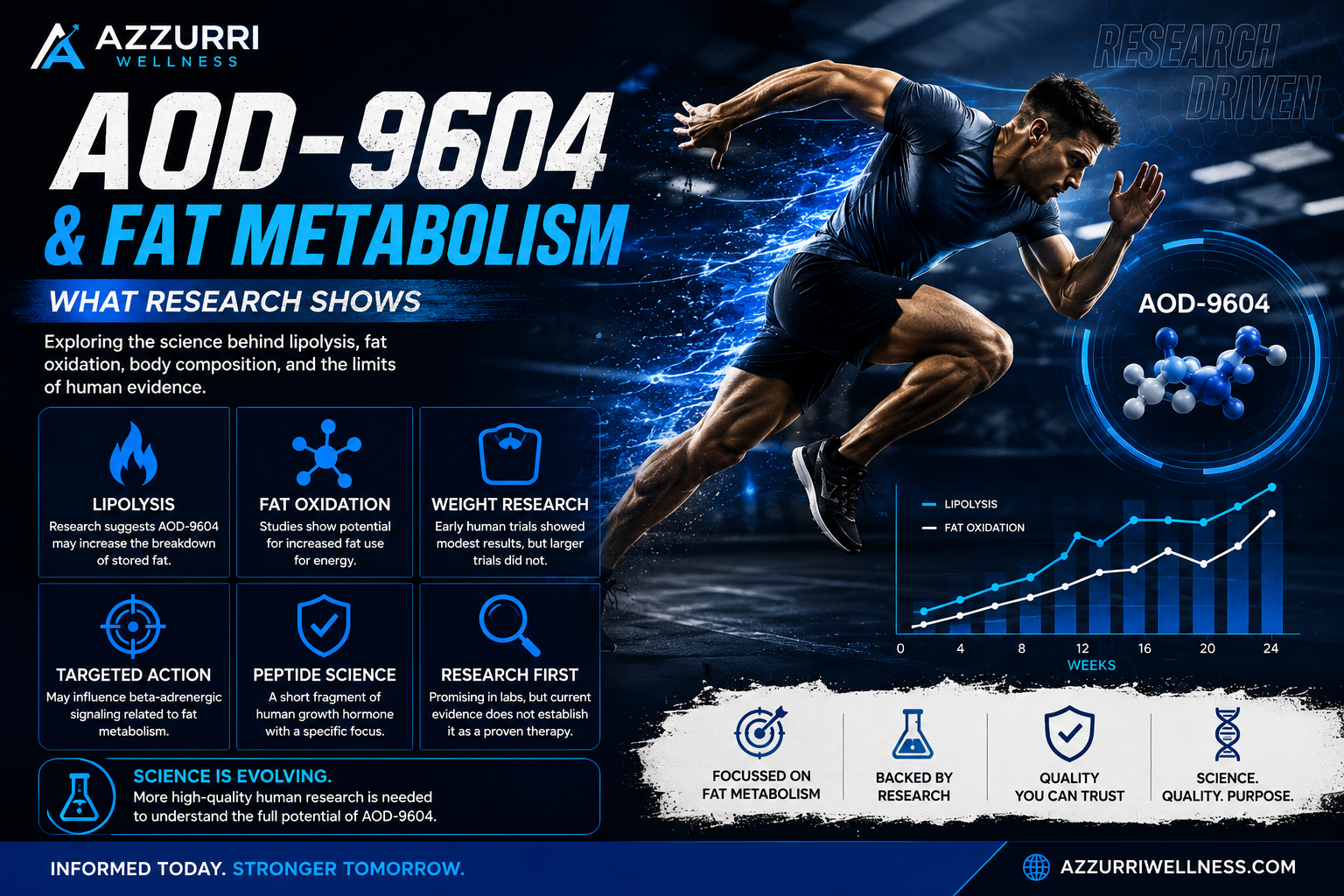
AOD-9604 and Fat Metabolism: What Research Shows About Lipolysis, Body Composition, and Human Evidence
AOD-9604 has been studied for possible effects on lipolysis, fat oxidation, body-weight regulation, and metabolic signaling.
What Is AOD-9604?
AOD-9604 is a modified fragment derived from the C-terminal region of human growth hormone.
It was developed to investigate whether some of growth hormone's effects on fat metabolism could be separated from its broader hormonal effects.
Early research focused heavily on lipolysis, fat oxidation, and body-weight regulation in animal models.
Researchers hoped that a smaller fragment might retain metabolic activity without reproducing all of the biological effects associated with full-length growth hormone.
Why Researchers Focused on Fat Metabolism
Fat metabolism involves several processes that determine how fat is stored, mobilized, and used for energy.
Lipolysis
Lipolysis refers to the breakdown of stored triglycerides into fatty acids that can be released from fat tissue.
Lipogenesis
Lipogenesis refers to the formation and storage of new fat.
Experimental research suggested that AOD-9604 could influence these processes in animal models, stimulating fat breakdown while reducing some aspects of fat storage.
This made the peptide an interesting candidate for obesity and metabolic research.
AOD-9604 and Lipolysis
Early studies evaluated AOD-9604 in animal models of obesity.
Researchers reported increased lipolytic activity in adipose tissue and reductions in body-weight gain in some experimental animals.
What the Animal Research Suggested
Other animal studies found that the peptide increased sensitivity to lipolytic signaling and altered body-fat accumulation.
These findings suggested that AOD-9604 was biologically active in pathways related to fat metabolism.
However, animal obesity models do not perfectly reproduce human obesity or human metabolism.
Fat Oxidation Research
Researchers also investigated whether AOD-9604 affected the body's use of fat for energy.
Fat oxidation is the process through which fatty acids are broken down to produce energy.
Experimental Findings
Animal studies have reported increased fat oxidation and reduced weight gain in some models involving obesity.
The possibility that AOD-9604 could influence fat utilization helped support further development of the peptide for obesity research.
Once again, the strongest early signals came from animal experiments.
Possible Beta-Adrenergic Signaling
Scientists have investigated how AOD-9604 may influence fat cells.
Experimental research suggested that some effects may involve beta-adrenergic pathways, particularly beta-3 adrenergic signaling in adipose tissue.
Why Beta-Adrenergic Pathways Matter
Beta-adrenergic receptors contribute to metabolic regulation and lipolysis.
Research suggested that AOD-9604 may increase the responsiveness of fat tissue to lipolytic signals rather than simply acting as a general stimulant.
This mechanism remains largely based on experimental research.
What Did Human Trials Find?
AOD-9604 progressed beyond animal studies and was evaluated in human obesity trials.
Some early clinical research appeared encouraging and reported modest differences in weight loss between certain AOD-9604 groups and placebo.
Why Early Results Were Not Enough
Early positive findings needed to be confirmed in larger and longer clinical trials before strong conclusions could be made.
This is an important step in drug development because small studies can sometimes produce results that do not remain consistent when larger populations are studied.
The Larger Trial Changed the Story
A larger 24-week clinical trial involving hundreds of participants did not demonstrate sufficient weight-loss efficacy.
This result became a major turning point in the clinical-development history of AOD-9604.
Why This Finding Matters
The larger trial showed that promising animal research and early clinical findings did not translate into consistent success in a larger human population.
This illustrates why early-stage research must be confirmed through larger and better-controlled human trials.
Why Dose-Response Matters
Another interesting feature of the human research was the lack of a straightforward dose-response relationship.
Participants receiving higher doses did not consistently demonstrate greater weight changes than participants receiving lower doses.
Interpreting Dose-Response Data
A predictable dose-response relationship can strengthen confidence that an observed effect is directly related to a compound.
The absence of a clear pattern made interpretation of AOD-9604's clinical effect more difficult.
AOD-9604 Is Not the Same as Full Growth Hormone
Because AOD-9604 originates from a region of human growth hormone, it is sometimes discussed as though it produces all of the same effects.
That is inaccurate.
AOD-9604 was specifically developed as a fragment intended to investigate metabolic actions associated with the lipolytic region of growth hormone.
Different Research Focus
The peptide should not automatically be expected to reproduce effects of full-length growth hormone on:
- Growth
- IGF-1 signaling
- Muscle development
- Other endocrine pathways
Its research history is primarily centered on fat metabolism.
What Animal Research Can and Cannot Tell Us
Animal research on AOD-9604 has reported increased fat oxidation, increased lipolytic activity, and reductions in body-weight gain in some obese rodent models.
These results helped justify further human research.
Why Human Results Matter More
Human biology is more complicated than animal models.
The later failure of a large obesity trial demonstrates why animal findings cannot automatically be translated into reliable weight-loss effects in humans.
That distinction is essential when discussing AOD-9604 responsibly.
What Current Research Does Not Establish
Current evidence does not prove that AOD-9604:
- Reliably produces significant weight loss
- Treats obesity
- Selectively removes abdominal fat
- Produces predictable fat loss in healthy adults
- Replaces diet, exercise, or established obesity therapies
- Builds muscle
- Produces the same effects as full growth hormone
- Guarantees improvement in body composition
The larger clinical-development program did not establish AOD-9604 as an effective obesity treatment.
Final Takeaway
AOD-9604 is a useful example of how peptide research can evolve from promising laboratory findings to more complicated human results.
Animal studies reported increased lipolysis, fat oxidation, and reduced weight gain, which supported investigation of AOD-9604 as a potential obesity therapy.
Some early human data also appeared encouraging.
However, a larger clinical trial failed to demonstrate sufficient weight-loss efficacy, and development of AOD-9604 as an obesity therapy was not successful.
For that reason, AOD-9604 is best understood as an interesting research peptide for studying fat metabolism rather than as a proven weight-management therapy.