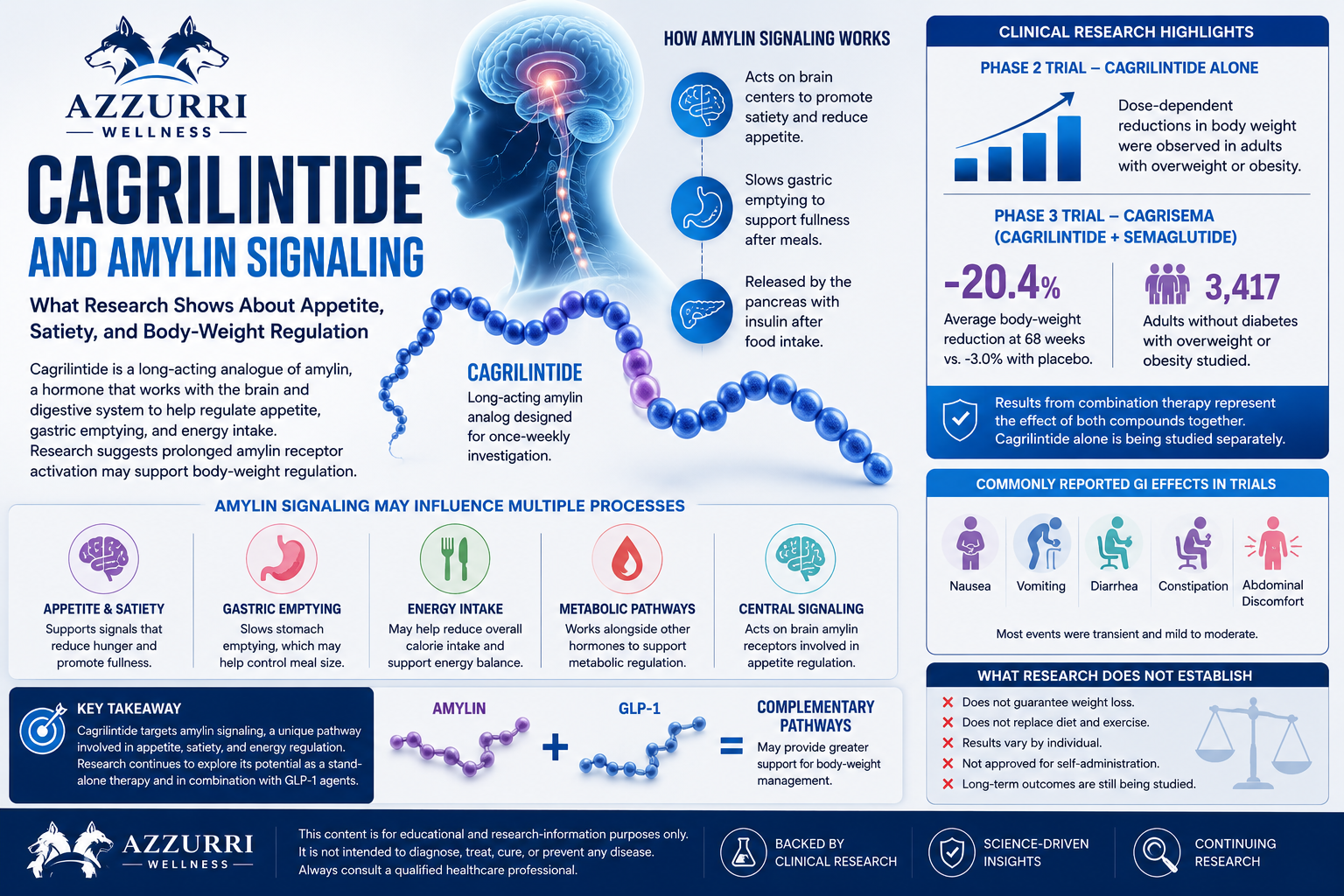
Cagrilintide and Amylin Signaling: What Research Shows About Appetite, Satiety, and Body-Weight Regulation
Cagrilintide research examines how prolonged amylin signaling may influence appetite, satiety, energy intake, and body-weight regulation.
What Is Cagrilintide?
Cagrilintide is a long-acting analogue of amylin, a peptide hormone normally released by pancreatic beta cells alongside insulin after food intake.
Amylin participates in the complex biological systems that regulate appetite, meal size, stomach emptying, and energy balance.
Cagrilintide was designed to extend amylin-related signaling over a longer period, allowing researchers to investigate sustained activity in clinical studies.
Randomized human research has reported dose-dependent body-weight changes in adults with overweight or obesity.
What Is Amylin?
Amylin is also known as islet amyloid polypeptide.
It is released after eating and functions as part of the body's communication system between the digestive tract, pancreas, and brain.
Rather than functioning simply as a “fat-burning hormone,” amylin primarily influences how the body responds to food intake.
Processes Associated With Amylin Signaling
- Satiety
- Meal size
- Gastric emptying
- Energy intake
- Central appetite pathways
Cagrilintide is scientifically interesting because it allows researchers to investigate whether prolonged activation of these pathways can meaningfully influence body-weight regulation.
Appetite Regulation Is More Than Hunger
Hunger is sometimes treated as though it were controlled by a single signal.
In reality, appetite involves a complex network of hormones, nerves, brain regions, digestive signals, and environmental cues.
Signals Involved in Appetite Regulation
- GLP-1
- Amylin
- PYY
- Ghrelin
- Insulin
- Leptin
These signals can influence when someone begins eating, how much they consume, and how long they feel satisfied afterward.
Cagrilintide research focuses specifically on the amylin side of this system.
How Cagrilintide Differs From GLP-1 Research
GLP-1 receptor agonists and amylin analogues influence body-weight regulation through overlapping but distinct biological pathways.
This distinction has become important because researchers are investigating whether targeting multiple appetite-related pathways can produce different effects from targeting only one.
Cagrilintide and Semaglutide
Cagrilintide has therefore been studied both as a standalone investigational compound and together with semaglutide.
The combined research program is commonly referred to as CagriSema.
Research involving the combination represents a separate scientific question from studies examining cagrilintide alone.
The Phase 2 Cagrilintide Trial
A major phase 2 study evaluated once-weekly cagrilintide in adults with overweight or obesity.
The trial was multicenter, randomized, double-blind, placebo-controlled, and active-controlled.
Researchers reported dose-dependent reductions in body weight, providing human evidence that prolonged amylin-receptor activity can influence body-weight regulation.
Why Human Trial Data Matters
Clinical studies are important because they move research beyond laboratory mechanisms and animal models.
They allow researchers to evaluate whether biological activity produces measurable outcomes in carefully monitored human populations.
Why Dose Response Matters
A dose-response relationship occurs when different exposure levels produce different magnitudes of effect.
In drug development, a consistent dose-response pattern can strengthen confidence that an observed biological outcome is related to the compound being investigated.
Phase 2 cagrilintide research reported greater body-weight reductions across increasing dose groups.
Efficacy Must Be Considered With Tolerability
Greater biological activity does not automatically mean a higher dose is always preferable.
Researchers must evaluate efficacy alongside tolerability, adverse events, treatment discontinuation, and overall safety.
Combining Amylin and GLP-1 Signaling
Researchers later investigated cagrilintide together with semaglutide.
Early clinical studies evaluated whether simultaneous activation of amylin and GLP-1-related pathways could produce complementary metabolic effects.
Why Combine the Two Pathways?
The scientific idea is relatively straightforward.
Amylin and GLP-1 both influence appetite and energy intake, but they do so through partly different biological systems.
Activating both pathways may therefore produce effects that differ from targeting either system alone.
What Phase 3 Research Found
Cagrilintide combined with semaglutide progressed into large phase 3 clinical trials.
In the REDEFINE 1 study, thousands of adults with overweight or obesity were randomized to receive cagrilintide-semaglutide, semaglutide alone, cagrilintide alone, or placebo alongside lifestyle interventions.
At 68 weeks, the combination group demonstrated substantial average body-weight reduction compared with placebo.
Why Combination Results Need Careful Interpretation
Results from combination therapy cannot be attributed entirely to cagrilintide.
When two biologically active compounds are administered together, the observed outcome represents the effect of the combined treatment strategy.
Cagrilintide Alone Versus Combination Research
This distinction is important when interpreting the scientific literature.
Cagrilintide has its own monotherapy research, including earlier phase 2 clinical trials.
CagriSema represents a separate research program involving simultaneous amylin and GLP-1 signaling.
Why Separating the Evidence Matters
Findings involving two compounds should not automatically be presented as evidence that either compound would produce the same result independently.
Keeping monotherapy and combination data separate helps prevent exaggerated conclusions.
Brain Amylin Receptors and Body-Weight Regulation
Researchers continue investigating exactly where cagrilintide produces its biological effects.
Experimental research has examined brain amylin and calcitonin receptor pathways and their possible involvement in body-weight regulation.
The Brain's Role in Appetite
Appetite regulation involves neural circuits rather than only digestive processes.
Signals from hormones, nutrients, and the gastrointestinal system are integrated within the central nervous system to influence eating behavior and energy regulation.
Cagrilintide research therefore sits at the intersection of endocrinology, metabolism, and neuroscience.
Gastrointestinal Effects in Clinical Trials
Appetite-regulating compounds can also influence gastrointestinal function.
In large clinical studies involving cagrilintide and semaglutide, gastrointestinal adverse events were frequently reported.
Commonly Reported Gastrointestinal Effects
- Nausea
- Vomiting
- Diarrhea
- Constipation
- Abdominal discomfort or pain
Many events in the clinical trials were described as transient and mild-to-moderate.
Safety and tolerability remain important when interpreting any weight-management research.
What Current Research Does Not Establish
Current evidence does not mean that cagrilintide:
- Guarantees weight loss
- Produces the same response in every individual
- Eliminates hunger completely
- Replaces nutrition or physical activity
- Produces combination-trial results when used alone
- Has identical effects to semaglutide
- Is appropriate for self-directed use
- Provides predictable long-term outcomes for every population
Clinical results apply to the specific populations, formulations, protocols, and monitoring systems used in the studies.
Why Cagrilintide Research Is Important
Cagrilintide broadens the scientific conversation around peptide-based metabolic research.
Much of the recent attention in weight-management science has centered on GLP-1 signaling.
Amylin represents another biological pathway involved in appetite and energy regulation.
Understanding how these pathways interact may help researchers build a more complete picture of appetite regulation and why combining complementary mechanisms can produce different effects from targeting one receptor system alone.
Final Takeaway
Cagrilintide is a long-acting amylin analogue being investigated for its effects on appetite, satiety, and body-weight regulation.
Randomized human trials have demonstrated dose-dependent changes with cagrilintide alone, while larger studies combining cagrilintide with semaglutide have reported substantial body-weight reductions.
The research demonstrates that amylin signaling represents a distinct and increasingly important area of metabolic science.
Cagrilintide is therefore useful for investigating how amylin pathways contribute to appetite, satiety, and long-term energy regulation.