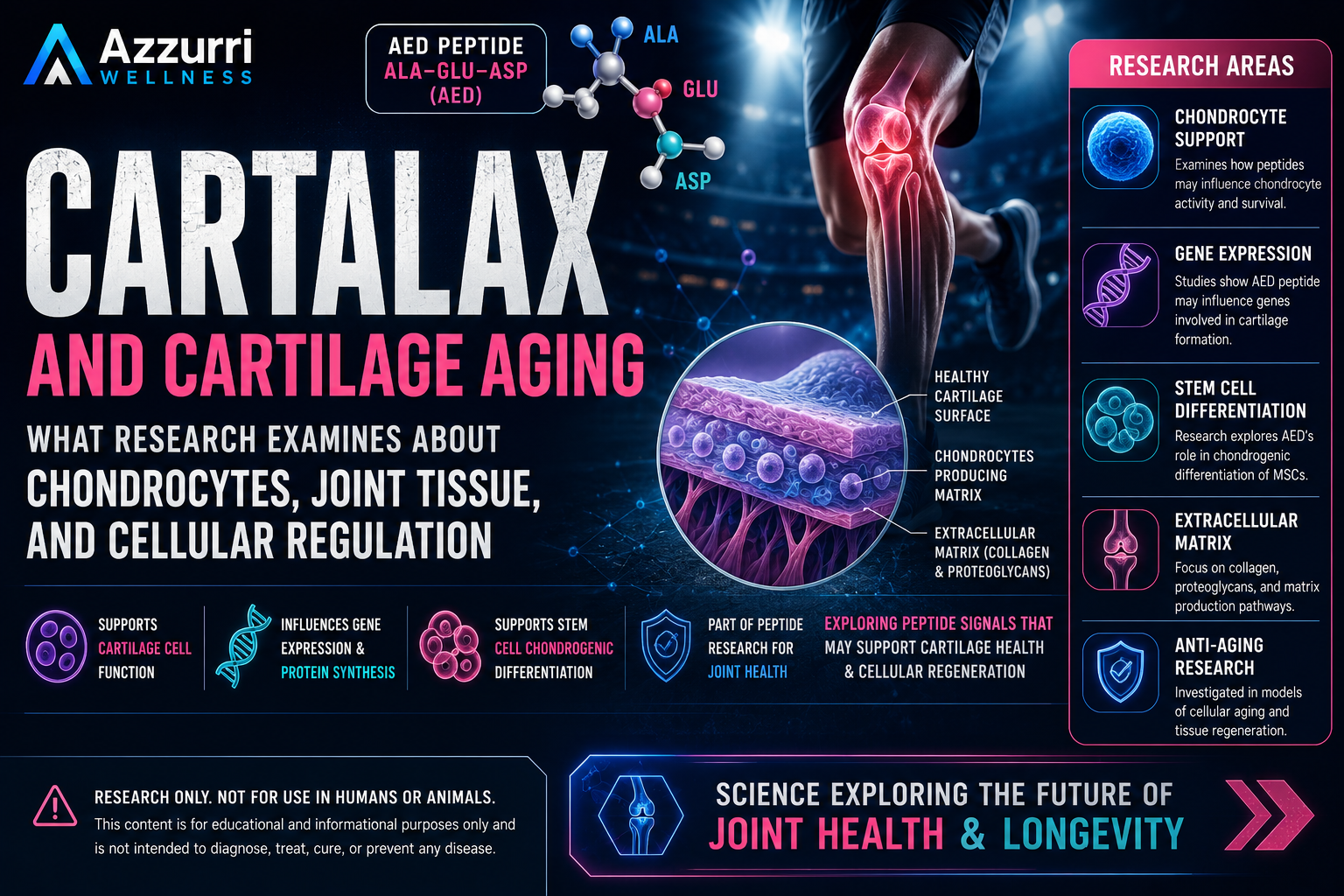
Cartalax and Cartilage Aging: What Research Examines About Chondrocytes, Joint Tissue, and Cellular Regulation
Research involving Cartalax and the AED peptide has examined cartilage aging, chondrogenic differentiation, gene expression, and cellular regulation.
What Is Cartalax?
Cartalax is commonly associated with the short peptide Ala-Glu-Asp, also known as AED, in peptide-bioregulator literature.
Research involving AED has examined cellular aging, gene expression, and the differentiation of mesenchymal stem cells toward cartilage-producing cells.
Why the AED Peptide Matters
Naming conventions for Cartalax are not completely consistent across commercial and secondary sources.
For that reason, the most scientifically useful approach is to focus on published research involving the AED peptide itself rather than assuming that every product marketed as Cartalax is biologically equivalent.
Why Cartilage Aging Matters
Articular cartilage is the specialized tissue covering the ends of bones inside many joints.
Unlike many other tissues, cartilage has limited intrinsic repair capacity.
Its maintenance depends heavily on chondrocytes, the cells responsible for producing and maintaining extracellular-matrix components such as collagen and proteoglycans.
Changes Associated With Cartilage Aging
As cartilage ages or becomes damaged, changes can occur in:
- Chondrocyte activity
- Extracellular-matrix production
- Cellular survival
- Inflammatory signaling
- Response to mechanical stress
- Stem-cell differentiation
Research into short peptides such as AED asks whether molecular signals may influence some of these cellular processes.
AED Peptide and Chondrogenic Differentiation
Experimental research has examined the effect of short peptides on the chondrogenic differentiation of human mesenchymal stem cells.
Studies involving AED have reported changes in gene expression and protein synthesis during cellular-aging models associated with cartilage-related differentiation.
What Is Chondrogenic Differentiation?
Mesenchymal stem cells can differentiate into several specialized cell types.
Chondrogenic differentiation is the process through which these cells develop toward a cartilage-producing phenotype.
Researchers study this process because successful cartilage repair requires not only more cells, but cells capable of producing the correct extracellular matrix.
Gene Expression and Cartilage Formation
Cartilage development depends on tightly regulated gene-expression programs.
Important proteins and regulatory factors associated with chondrogenic differentiation include:
- Type II collagen
- Aggrecan
- SOX9
- Other extracellular-matrix proteins
Signaling Pathways in Cartilage Research
Peptide-based cartilage research has examined several signaling systems, including:
- WNT signaling
- ERK-p38 pathways
- Smad-related signaling
These pathways influence chondrogenic differentiation and cartilage-matrix production.
Research involving AED suggests that short peptides can influence gene-expression and protein-synthesis patterns during cellular aging.
This remains mechanistic research rather than evidence that Cartalax rebuilds damaged human joints.
Chondrocytes: The Cells That Maintain Cartilage
Chondrocytes are the primary cells responsible for maintaining articular cartilage.
They produce the extracellular matrix that gives cartilage its ability to remain smooth while resisting compression and repeated mechanical loading.
Why Chondrocyte Health Matters
When chondrocytes lose function or die, cartilage becomes increasingly difficult to maintain.
Modern cartilage research therefore examines not only structural damage but also cellular survival and signaling within chondrocytes.
Cartilage Aging Is More Than Wear and Tear
Aging joints are sometimes described simply as becoming mechanically “worn out.”
The underlying biology is much more complicated.
Cartilage aging can involve:
- Altered gene expression
- Changes in extracellular-matrix turnover
- Oxidative stress
- Cellular senescence
- Inflammatory signaling
- Reduced regenerative capacity
This is one reason short regulatory peptides have become an area of experimental interest.
Rather than acting simply as structural building blocks, researchers are investigating whether certain peptide sequences can influence how cells behave.
Stem Cells and Cartilage Repair Research
Regenerating durable articular cartilage remains challenging.
Researchers have explored mesenchymal stem cells because of their ability to differentiate toward chondrocytes.
However, creating stable cartilage that maintains the correct cellular phenotype and extracellular matrix remains difficult.
Why Peptides Are Being Investigated
Peptides are being studied as one possible way of influencing stem-cell differentiation and cartilage-related signaling.
Experimental peptide strategies have explored pathways associated with:
- Stem-cell recruitment
- Chondrogenesis
- Extracellular-matrix formation
- Cellular differentiation
AED belongs to this broader scientific conversation about whether very short peptide signals can influence age-sensitive cellular programs.
Extracellular Matrix and Joint Structure
Cartilage is composed largely of extracellular matrix rather than cells.
This matrix contains specialized collagen and proteoglycan networks that allow cartilage to remain smooth while resisting compression.
Maintaining the Matrix
Healthy cartilage depends on a balance between matrix synthesis and degradation.
When degradation exceeds production, cartilage structure can progressively deteriorate.
Peptide research therefore examines not only whether cells survive but also whether they produce proteins required for a healthy cartilage matrix.
What Does the AED Research Actually Show?
The strongest recent evidence relevant to Cartalax comes from cellular research.
Experimental studies have reported that AED can influence gene expression and protein synthesis in aging mesenchymal stem-cell models during chondrogenic differentiation.
What These Findings Do Not Prove
Demonstrating biological activity in a cellular model does not establish that AED or Cartalax:
- Regenerates cartilage inside human joints
- Reverses osteoarthritis
- Eliminates joint pain
- Restores damaged knees
- Prevents cartilage loss
- Produces clinically meaningful improvements in mobility
These questions require controlled human research.
Why Human Evidence Matters
Cell-culture experiments allow scientists to isolate pathways and investigate mechanisms under controlled conditions.
They are extremely useful for understanding biology.
However, a human joint is much more complicated.
From Laboratory Activity to Clinical Effect
For a peptide to produce meaningful effects in human cartilage, several conditions would need to be met.
The peptide would need to:
- Reach the relevant tissue
- Remain biologically active
- Influence the correct cellular pathways
- Produce meaningful structural or functional improvement
- Demonstrate an acceptable safety profile
These steps cannot be assumed from an in-vitro finding.
Cartalax and Healthy Aging Research
Cartilage aging is particularly interesting because joints experience both biological aging and decades of mechanical loading.
That combination means future cartilage strategies may need to address several systems simultaneously.
These may include:
- Cell survival
- Matrix synthesis
- Inflammatory balance
- Mechanical loading
- Stem-cell differentiation
- Tissue architecture
AED research contributes to this broader field by examining how short peptides influence age-sensitive cellular pathways involved in chondrogenic differentiation.
What Current Research Does Not Establish
Current evidence does not prove that Cartalax or AED:
- Reverses cartilage aging
- Rebuilds damaged joints
- Treats osteoarthritis
- Reliably reduces joint pain
- Prevents cartilage degeneration
- Restores athletic performance
- Replaces physical therapy or established medical treatment
- Produces predictable benefits in healthy adults
- Has established long-term safety for therapeutic human use
The available evidence remains largely experimental.
Final Takeaway
Cartalax is an interesting topic in peptide research because the associated AED peptide has been investigated in cellular models involving aging and chondrogenic differentiation.
Experimental work indicates that AED can influence gene expression and protein synthesis in aging mesenchymal stem cells undergoing cartilage-related differentiation.
Broader peptide research also demonstrates that short peptide signals can influence pathways involved in chondrocyte differentiation, extracellular-matrix production, and cartilage-regeneration research.
The evidence does not establish Cartalax as a proven joint-repair or osteoarthritis therapy.
Its current scientific value lies in understanding how small peptide signals may interact with cellular programs involved in cartilage formation, aging, and tissue maintenance.