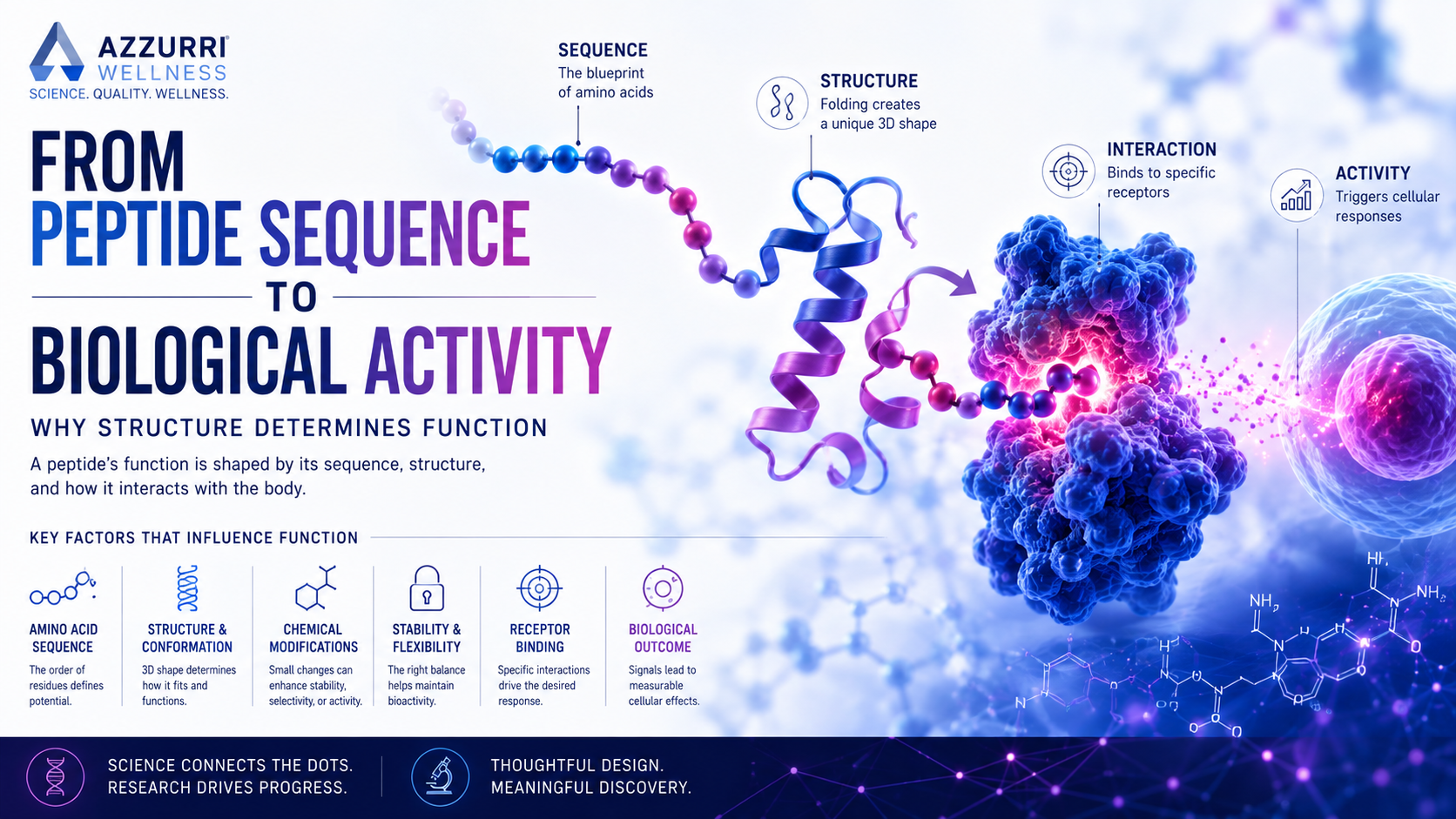
From Peptide Sequence to Biological Activity
A peptide begins as a sequence of amino acids.
Yet biological activity depends on much more than the order of those amino acids.
The sequence influences how the molecule folds, which chemical groups are exposed, how flexible the molecule is, and how it interacts with other biological molecules.
For researchers, this creates a fundamental relationship:
Sequence → structure → molecular interaction → biological activity
The relationship is not always linear or predictable, but it provides one of the central frameworks for understanding peptide biology.
Primary Structure: The Peptide Sequence
The primary structure of a peptide is its amino-acid sequence.
Changing one amino acid can alter the chemical characteristics of a region without changing the overall length of the peptide.
Different amino acids contribute different properties:
- Positive or negative charge
- Hydrophobicity
- Polarity
- Hydrogen-bonding capacity
- Steric bulk
- Flexibility
- Aromaticity
Consequently, two peptides with similar lengths can behave differently because their sequences produce different chemical and structural environments.
This is one reason peptide research frequently uses sequence modifications to investigate structure-activity relationships.
Secondary Structure: Local Organization
Peptide chains can adopt local structural patterns such as:
- α-helices
- β-sheets
- Turns
- Loops
Not every peptide maintains a single stable secondary structure.
Some peptides are highly structured, while others remain relatively flexible in solution.
The environment also matters.
pH, temperature, solvent composition, ionic strength, and interactions with other molecules can influence peptide conformation.
A peptide may therefore have one structural preference in solution and another when interacting with a receptor.
Tertiary Structure: The Three-Dimensional Arrangement
When structural elements interact, they can produce a more complex three-dimensional organization.
This is especially important for larger peptides and peptides containing stabilizing features such as disulfide bonds.
The three-dimensional structure determines which chemical groups are exposed and which are buried.
That can influence molecular recognition.
A receptor does not interact with an abstract sequence.
It interacts with a three-dimensional molecular surface.
This is why structural changes can have effects that are disproportionate to the apparent size of the chemical modification.
A Small Modification Can Have a Large Effect
Consider a hypothetical peptide containing a residue that directly participates in receptor recognition.
Replacing that residue might change:
- Charge
- Hydrogen bonding
- Steric interactions
- Molecular orientation
- Local flexibility
The peptide may still have nearly the same molecular weight and length, yet its receptor interaction could change substantially.
Experimental structure-activity studies provide numerous examples of this principle.
Research involving peptide hormones has demonstrated how structural constraints and helix formation can influence receptor activation.
The lesson is important:
More structure is not automatically better structure.
The biologically relevant conformation depends on the specific peptide and target.
Shape and Function Are Connected
A receptor recognizes molecular features in three dimensions.
Those features can include:
- Charge distribution
- Hydrophobic surfaces
- Hydrogen-bond donors
- Hydrogen-bond acceptors
- Aromatic groups
- Flexible regions
- Rigid structural elements
A peptide therefore needs to present the right molecular features in an appropriate spatial arrangement.
This is sometimes described through the concept of structure-activity relationships, or SAR.
Researchers systematically change molecular structure and observe how the biological response changes.
Over time, these experiments can identify which parts of a peptide are most important for activity.
Flexible Versus Constrained Peptides
Flexibility can be useful.
A flexible peptide may be able to adapt to a receptor binding site.
But flexibility can also make structural analysis more complicated because the peptide may exist as multiple conformations.
Researchers have explored this problem by creating conformationally constrained analogues.
The idea is to restrict movement and determine whether a particular structural arrangement improves, reduces, or changes receptor interaction.
Such approaches have contributed to the design and study of peptide ligands with altered receptor selectivity and biological properties.
Disulfide Bonds Can Reshape a Peptide
Cysteine residues can form disulfide bonds.
These bonds can bring distant portions of a peptide chain together and dramatically influence its three-dimensional organization.
For peptides that naturally depend on disulfide bonds, disrupting or rearranging those bonds can change molecular structure and therefore potentially alter receptor recognition.
This is particularly important when studying peptides whose biological activity depends on a defined three-dimensional fold.
Sequence Does Not Tell the Entire Story
A common mistake in peptide research is to treat the amino-acid sequence as if it completely describes the molecule's biological behavior.
Sequence is essential, but it is only the starting point.
Other variables include:
- Three-dimensional conformation
- Chemical modifications
- Disulfide connectivity
- Terminal groups
- Local environment
- Aggregation state
- Receptor structure
- Binding orientation
- Molecular dynamics
Even the same sequence can behave differently under different experimental conditions.
This is why researchers characterize peptides using multiple analytical and biochemical approaches rather than relying on sequence information alone.
The Role of Chemical Modifications
Synthetic peptide research often involves chemical modifications designed to alter molecular properties.
Examples of Peptide Modifications
- Terminal modifications
- Lipidation
- Cyclization
- Amino-acid substitutions
- Backbone modifications
- Disulfide engineering
These modifications may influence molecular stability, receptor recognition, conformational preferences, or pharmacokinetic behavior.
However, a modification that improves one property can sometimes negatively affect another.
For example, increasing structural rigidity may improve one receptor interaction while reducing flexibility required elsewhere.
Peptide design is therefore often an optimization problem rather than a search for one universally ideal structure.
Structure Can Influence Receptor Selectivity
Receptors within the same biological family can have highly similar structures.
Small differences in their binding environments can nevertheless influence ligand recognition.
Peptide receptor research has shown that particular peptide regions and receptor residues contribute to selective recognition.
This is one reason structure-activity studies are valuable.
By changing individual residues and measuring receptor binding or signaling, researchers can begin to identify the molecular features associated with selectivity.
Binding and Biological Activity Are Different Measurements
Another important distinction is between binding affinity and functional activity.
A peptide can bind strongly to a receptor without producing the same downstream response as another ligand.
Conversely, a structural modification might preserve measurable binding while substantially changing signaling.
Affinity
How strongly does the peptide bind?
Selectivity
Which receptors does it prefer?
Efficacy
What happens after binding?
Potency
What concentration is required to produce a defined response in a particular experimental system?
These measurements answer different questions and should not be treated as interchangeable.
How Researchers Connect Structure With Function
Sequence Modification
Individual amino acids can be substituted or removed to identify important regions.
Circular Dichroism
CD spectroscopy can provide information about secondary structural characteristics.
Nuclear Magnetic Resonance
NMR can provide detailed information about peptide conformation and molecular dynamics.
X-Ray Crystallography and Cryo-EM
These approaches can reveal high-resolution structures of peptide-receptor complexes when suitable samples and experimental conditions are available.
Mass Spectrometry
Mass spectrometry can help confirm molecular mass and characterize modifications or degradation products.
Functional Assays
Cellular assays can determine whether structural changes alter downstream signaling.
Combining these techniques provides a much stronger picture than any single measurement.
Why Structure-Activity Relationships Matter
Structure-activity research allows scientists to move from observation toward mechanism.
Instead of simply observing that:
Peptide A produces response X
researchers can ask:
Which structural features are responsible for response X?
That question can lead to experiments involving:
- Truncation
- Substitution
- Cyclization
- Conformational restriction
- Terminal modification
- Receptor mutagenesis
- Structural analysis
Over time, these studies can reveal relationships between molecular structure and biological function.
The Azzurri Wellness Perspective
Peptide science is often introduced through amino-acid sequences and molecular formulas.
But biological activity emerges from a much richer relationship between sequence, structure, molecular dynamics, receptor recognition, and signaling.
A useful conceptual framework is:
Primary sequence → molecular conformation → receptor interaction → receptor signaling → measurable biological response
Each step can introduce variables that researchers need to investigate.
That is why rigorous peptide research combines chemical characterization with structural and biological testing.
Understanding structure does not automatically predict every biological outcome—but it provides a powerful framework for asking better scientific questions.