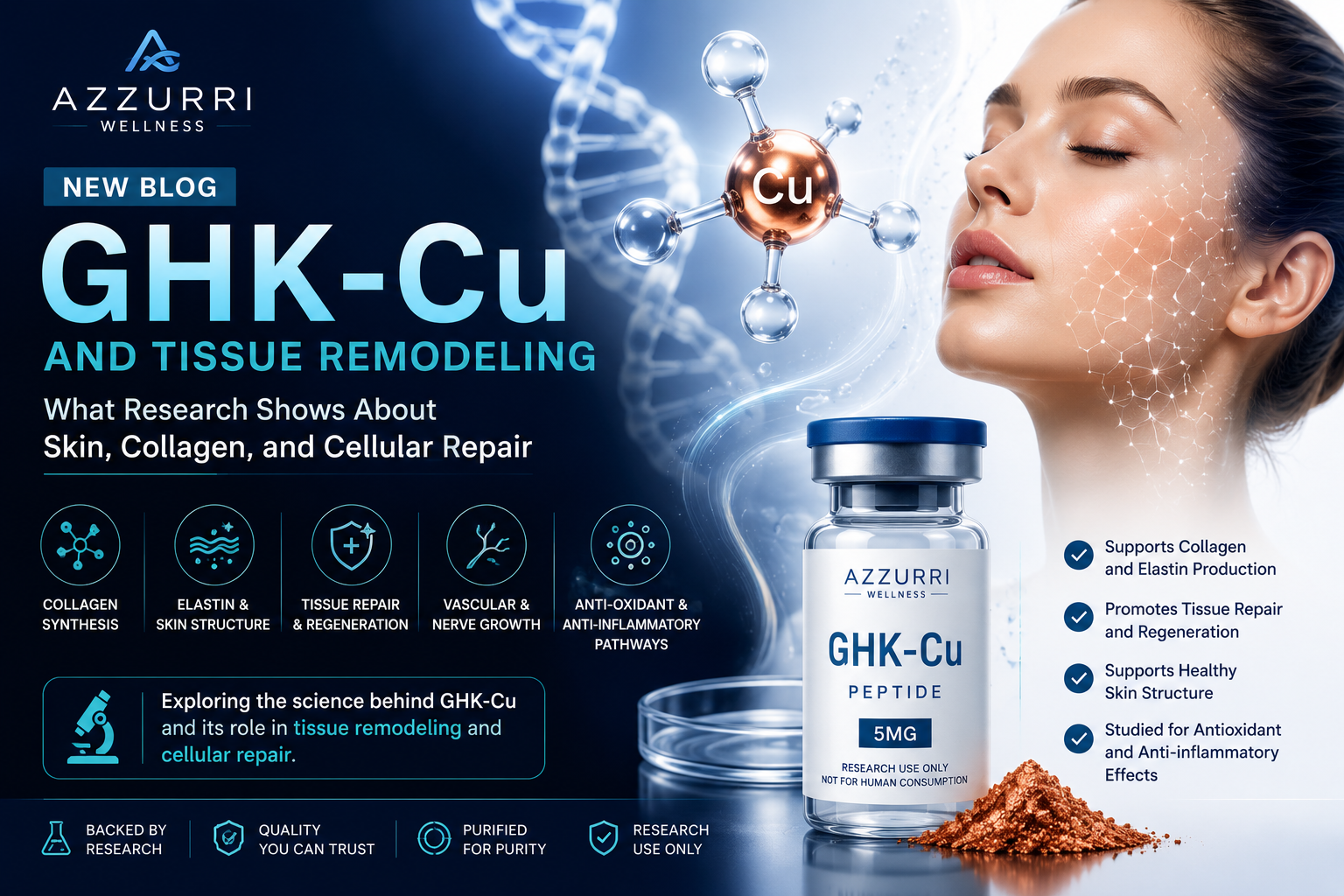
GHK-Cu and Tissue Remodeling: What Research Shows About Skin, Collagen, and Cellular Repair
GHK-Cu has been studied for its possible role in collagen synthesis, tissue remodeling, cellular repair, skin structure, and wound-related processes.
What Is GHK-Cu?
GHK-Cu is the copper complex of the naturally occurring tripeptide glycyl-L-histidyl-L-lysine, commonly abbreviated as GHK.
Researchers have studied this copper-binding peptide for decades because of its reported involvement in tissue remodeling, collagen synthesis, cellular repair, inflammatory signaling, and wound-related processes.
Unlike many synthetic research peptides, GHK is naturally present in the human body.
Its ability to bind copper is central to much of the scientific interest surrounding its biological activity.
Why Copper Matters
Copper is required for several enzymes involved in connective-tissue biology.
When bound to GHK, copper may be delivered or regulated in ways that influence cellular processes involved in tissue repair and extracellular-matrix remodeling.
Processes Studied With GHK-Cu
Experimental research has associated GHK-Cu with several biological processes, including:
- Collagen production
- Elastin synthesis
- Glycosaminoglycan production
- Fibroblast activity
- Extracellular-matrix remodeling
This does not mean GHK-Cu acts as a simple “collagen booster.”
Its biological effects appear to involve multiple signaling and repair pathways.
GHK-Cu and Collagen Research
Collagen is one of the major structural proteins in skin and connective tissue.
Research reviews describe GHK-Cu as influencing collagen synthesis and extracellular-matrix remodeling.
The Role of Fibroblasts
GHK-Cu has also been reported to influence dermal fibroblast activity.
Fibroblasts are important because they help produce collagen and other structural components of the skin.
These findings help explain why copper peptides have attracted attention in both regenerative biology and cosmetic dermatology.
Elastin and Skin Structure
Collagen provides much of the skin's structural strength, while elastin helps tissues stretch and return to their original shape.
Reviews of GHK-Cu research describe increased synthesis of both collagen and elastin in experimental systems.
Why Researchers Study Skin Structure
These findings have led researchers to explore whether GHK-Cu may influence:
- Skin firmness
- Elasticity
- Texture
- Tissue resilience
- Visible characteristics associated with skin aging
However, findings from experimental systems should not automatically be generalized to every formulation or method of use.
Human Skin Research
GHK-Cu is unusual among many research peptides because some controlled human studies involving aged skin have been reported.
Reviews of GHK and tissue remodeling describe studies in which topical copper-peptide formulations were associated with improvements in skin firmness, elasticity, thickness, and the appearance of wrinkles and photodamage.
Why Formulation Matters
This research involved specific topical formulations.
The findings do not automatically support claims for every concentration, delivery method, or commercial product.
Evidence involving topical cosmetic formulations should not be generalized to systemic or injectable use.
GHK-Cu and Tissue Repair
Another major area of GHK-Cu research involves wound and tissue repair.
Reviews report that GHK-Cu has demonstrated wound-related activity across multiple experimental models and has also been investigated in human research.
Biological Processes Involved in Repair
GHK-Cu has been associated with processes including:
- Fibroblast activity
- Collagen formation
- Blood-vessel growth
- Extracellular-matrix remodeling
- Inflammatory signaling
- Tissue regeneration
These effects make GHK-Cu an interesting model for studying how peptide signaling may influence the tissue-repair environment.
Blood Vessel and Nerve Growth Research
Research reviews also describe GHK-Cu as influencing blood-vessel and nerve outgrowth in experimental settings.
Why Vascular Growth Matters
New blood-vessel formation can be important during tissue repair because healing tissues require oxygen and nutrients.
These findings are mechanistic and should not be interpreted as proof of a therapeutic benefit for specific diseases.
Antioxidant and Inflammatory Pathways
GHK-Cu research has also explored oxidative stress and inflammatory signaling.
Research reviews describe antioxidant and anti-inflammatory effects in cell and animal studies alongside findings involving remodeling and regeneration.
Why These Pathways Matter
Chronic oxidative stress and dysregulated inflammation can affect tissue quality and cellular function.
Studying how GHK-Cu interacts with these pathways may help researchers better understand its broader role in tissue biology.
However, much of this evidence remains preclinical.
Why GHK-Cu Is Studied in Aging Research
Aging affects skin structure, collagen organization, cellular repair, and tissue resilience.
Because GHK-Cu appears to influence several of these biological systems, researchers have investigated it as a potential model for studying age-related tissue changes.
Understanding the Term “Anti-Aging”
The phrase “anti-aging peptide” can be misleading if it implies that GHK-Cu can slow or reverse biological aging as a whole.
Current evidence does not establish that.
Research is better interpreted in the context of specific tissue-remodeling, skin, repair, and cellular-signaling processes.
What Current Research Does Not Establish
Current evidence does not prove that GHK-Cu:
- Reverses biological aging
- Reliably restores youthful skin
- Heals every type of wound
- Produces the same results through every delivery method
- Prevents age-related disease
- Guarantees increased collagen in every person
- Produces predictable whole-body regenerative effects
The strongest evidence relates to specific tissue-remodeling mechanisms and some topical skin research rather than broad systemic rejuvenation.
Final Takeaway
GHK-Cu is one of the more extensively studied copper-binding peptides in tissue-remodeling research.
Studies and reviews have examined its relationship with collagen, elastin, fibroblast activity, extracellular-matrix remodeling, wound-related repair, vascular growth, and inflammatory signaling.
Some human skin studies provide an additional level of evidence that is not available for many experimental peptides, particularly for topical use.
Those findings should still be interpreted within the specific formulation and research context in which they were produced.
GHK-Cu therefore remains an important peptide for studying how molecular signaling may influence tissue structure, repair, and age-related changes without assuming broader anti-aging or regenerative benefits that the evidence has not established.