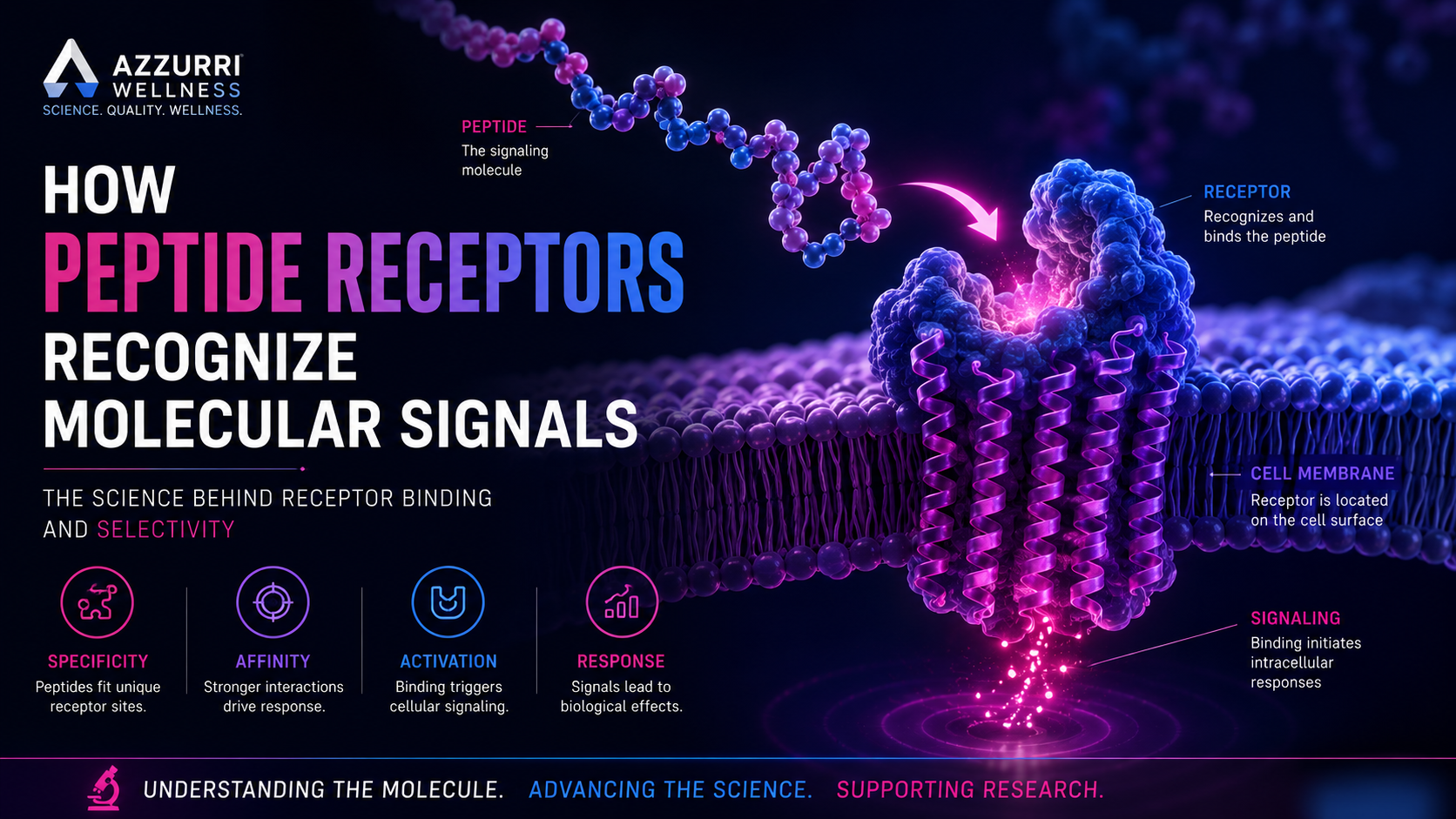
How Peptide Receptors Recognize Molecular Signals
Peptides are among the most versatile signaling molecules in biology. They can act as hormones, neurotransmitters, local signaling molecules, and regulators of cellular activity. Their effects begin with a fundamental molecular event: recognition by a biological target.
For many peptide hormones and signaling molecules, that target is a receptor.
But receptor recognition is more complicated than a simple “lock-and-key” model. Peptides and receptors are flexible molecules, and their interaction can involve multiple contact points, conformational changes, electrostatic interactions, hydrogen bonding, hydrophobic interactions, and changes in molecular orientation.
Understanding these interactions helps explain an important principle in peptide research:
A peptide's sequence influences how it interacts with a receptor, while its three-dimensional structure can influence what happens after binding.
What Is a Peptide Receptor?
A receptor is a biological macromolecule that recognizes a particular signaling molecule and converts that recognition event into a cellular response.
Many peptide hormones interact with receptors located on the surface of cells. One major receptor family involved in peptide signaling is the G protein-coupled receptor (GPCR) family.
GPCRs contain seven membrane-spanning α-helices and can respond to extracellular ligands by undergoing structural changes that influence intracellular signaling proteins.
Other peptide receptors belong to different structural families, including receptors with extracellular ligand-binding domains and intracellular enzymatic or signaling components.
The receptor family matters because different receptors recognize peptides through different molecular mechanisms.
Recognition Begins With Molecular Complementarity
A receptor does not simply recognize a peptide because the two molecules have complementary shapes.
Recognition can involve several types of molecular interactions:
- Hydrogen bonds
- Electrostatic interactions
- Hydrophobic interactions
- Van der Waals forces
- Aromatic interactions
- Disulfide-dependent structural features
- Shape complementarity
The precise combination depends on the peptide and receptor.
A peptide may contain several residues that contribute to receptor recognition, but those residues do not necessarily contribute equally.
Some residues may be essential for binding, while others may influence receptor activation, stability, or the orientation of the peptide within the binding site.
This is why changing a single amino acid can sometimes produce a substantial change in biological activity.
Binding Affinity and Receptor Selectivity
What Is Binding Affinity?
Affinity describes how strongly a ligand interacts with a receptor.
What Is Receptor Selectivity?
Selectivity describes the preference for one receptor or receptor subtype over others.
A peptide can have strong affinity for a receptor without necessarily producing the same functional response as another ligand.
This distinction matters because receptor binding is only one part of signaling.
Researchers may therefore examine several properties separately:
- Receptor binding
- Binding affinity
- Receptor selectivity
- Receptor activation
- Downstream signaling
- Functional response
A molecule that binds a receptor does not automatically behave as a full agonist. Depending on the molecular interaction, ligands can act as agonists, partial agonists, antagonists, or other pharmacological classes.
Why Amino-Acid Sequence Matters
Peptides are chains of amino acids, and their sequence provides the basic molecular information from which their structure and interactions emerge.
Changing an amino acid can alter:
- Charge
- Polarity
- Hydrophobicity
- Flexibility
- Hydrogen-bonding potential
- Steric properties
- Local conformation
These changes can influence receptor recognition.
For example, experimental structure-activity studies have shown that substitutions at specific peptide positions can alter receptor affinity and functional activity.
This illustrates why peptide research often uses alanine scanning, substitution studies, truncation experiments, and other structure-activity approaches.
Researchers systematically modify individual residues and measure what changes.
The result is a map of which portions of the peptide contribute to recognition and which contribute to activation.
The Peptide Does Not Always Have One Fixed Shape
One of the more interesting features of peptide biology is molecular flexibility.
Many relatively small peptides do not maintain a single rigid three-dimensional structure in solution. Instead, they can exist as ensembles of different conformations.
When the peptide encounters its receptor, the interaction can favor a particular conformation.
Conformational Selection
In conformational selection, a receptor preferentially binds one of the conformations that already exists within the peptide's structural ensemble.
Induced Fit
In induced fit, interaction with the receptor contributes to a structural change that helps form the final complex.
Experimental approaches including NMR, crosslinking, spectroscopy, and structural biology have been used to investigate these dynamic interactions.
This makes peptide-receptor recognition a dynamic molecular process rather than a rigid docking event.
Why Receptor Binding Does Not Automatically Equal Activation
A useful distinction in peptide research is:
Binding does not necessarily equal activation.
A peptide can interact with a receptor without producing the same conformational change produced by another ligand.
Receptors are dynamic proteins. When a ligand binds, it can stabilize particular receptor conformations.
Those conformations can influence downstream signaling pathways.
For GPCRs, for example, ligand binding can alter the receptor's intracellular conformation and affect interactions with intracellular signaling proteins.
This helps explain why two molecules can bind to the same receptor while producing different signaling profiles.
The Role of the Receptor Itself
It is tempting to think of receptor recognition as something determined entirely by the peptide.
In reality, both sides of the interaction matter.
Receptors contain specific amino acids and structural regions that form the ligand-binding environment.
Studies of peptide GPCRs have shown that particular receptor residues can influence which peptide termini and chemical groups are preferentially recognized.
This creates a molecular conversation between ligand and receptor:
Peptide structure → receptor recognition → receptor conformational change → intracellular signaling
Changing either participant can alter the interaction.
Why Selectivity Matters in Peptide Research
Many biological systems contain closely related receptors.
A peptide may therefore encounter multiple potential targets.
Selectivity becomes especially important when researchers want to understand whether a particular biological effect is associated with one receptor rather than another.
Researchers can investigate selectivity through:
- Binding assays
- Receptor-expression systems
- Mutational studies
- Structure-activity relationships
- Functional signaling assays
- Structural biology
- Computational modeling
How Scientists Study Peptide-Receptor Interactions
Binding Assays
These determine whether a peptide interacts with a receptor and can help quantify affinity.
Functional Assays
These examine whether receptor binding produces a measurable cellular signal.
Examples can include changes in:
- cAMP
- Calcium signaling
- β-arrestin recruitment
- Phosphorylation
- Gene expression
Mutagenesis
Researchers can change individual receptor or peptide residues and determine whether the interaction changes.
Structural Biology
Cryo-electron microscopy, X-ray crystallography, and NMR can provide information about molecular structure and interaction sites.
Computational Modeling
Molecular modeling and docking can help generate hypotheses about potential binding orientations and interactions, although computational predictions generally require experimental validation.
From Molecular Recognition to Biological Research
Understanding peptide-receptor recognition provides a framework for interpreting peptide research more critically.
Instead of asking only, “What does this peptide do?”, researchers can ask a series of more precise questions:
- Which receptor does it interact with?
- Which residues are involved?
- How strong is the interaction?
- Is the peptide selective?
- Does binding activate the receptor?
- Which signaling pathway is engaged?
- Does receptor binding differ between experimental systems?
- What structural evidence supports the proposed mechanism?
These questions help separate molecular evidence from assumptions.
The Azzurri Wellness Perspective
Peptide signaling begins with molecular recognition, but recognition is only the first step in a much larger biological process.
Sequence, structure, receptor architecture, binding affinity, conformational dynamics, and downstream signaling can all contribute to the final observed response.
For peptide research, this reinforces an important principle:
Understanding the molecule requires looking beyond its amino-acid sequence alone.
A peptide's biological behavior emerges from the relationship between its molecular structure and its biological environment.