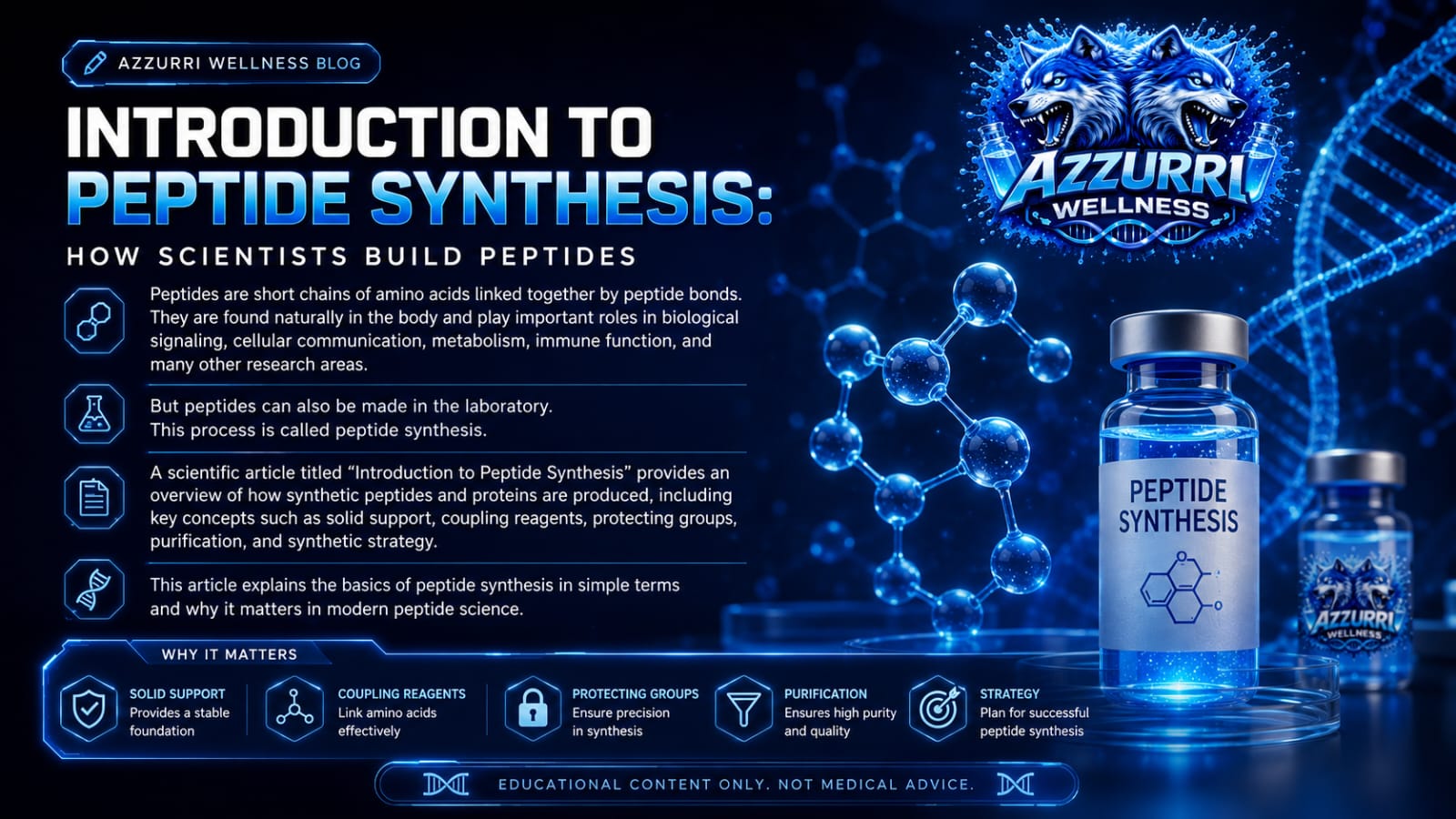
Peptides are short chains of amino acids linked together by peptide bonds. They occur naturally in the body and play important roles in biological signaling, cellular communication, metabolism, immune function, and many other areas of study.
Peptides can also be built in the laboratory. That process is called peptide synthesis.
A scientific overview titled "Introduction to Peptide Synthesis" describes how synthetic peptides and proteins are produced, covering key concepts such as solid support, coupling reagents, protecting groups, purification, and synthetic strategy. This article explains those basics in plain terms and why they matter in modern peptide science.
What Is Peptide Synthesis?
Peptide synthesis is the process of building peptides by linking amino acids together in a specific order.
Each amino acid carries chemical groups that can react with other amino acids. During synthesis, scientists carefully control these reactions so the amino acids connect in the correct sequence. The goal is a peptide with a defined structure and composition.
In simple terms:
- Amino acids are the building blocks.
- Peptide bonds are the links.
- Peptide synthesis is the controlled assembly process.
Why Peptide Synthesis Matters
Peptide synthesis is important because it lets scientists create peptides for research, testing, and development.
Synthetic peptides can be used to study:
- Protein structure
- Cell signaling
- Receptor binding
- Enzyme activity
- Immune responses
- Drug discovery
- Peptide stability
- Biological pathways
Without peptide synthesis, many areas of peptide research would be far more difficult to explore.
Solid-Phase Peptide Synthesis
One of the most important methods in peptide synthesis is solid-phase peptide synthesis, often shortened to SPPS.
In SPPS, the growing peptide chain is attached to a solid support, usually a resin. Scientists add amino acids one at a time while the peptide stays connected to that support. This approach is easier to control because excess reagents and byproducts can be washed away after each step.
The general process includes:
- Attaching the first amino acid to the resin
- Removing a temporary protecting group
- Adding the next protected amino acid
- Forming a peptide bond
- Washing away extra reagents
- Repeating the cycle until the sequence is complete
- Cleaving the finished peptide from the resin
This step-by-step method transformed peptide chemistry and made synthetic peptides far more accessible for research.
Why Protecting Groups Are Needed
Amino acids contain multiple reactive chemical groups. If every reactive part were allowed to react freely, unwanted side reactions could occur.
To prevent this, scientists use protecting groups. These temporarily block certain parts of the amino acid so the desired peptide bond forms in the correct place.
Two common strategies used in peptide synthesis are:
- Fmoc chemistry
- Boc chemistry
These approaches use different protecting groups and different chemical conditions for removing them. Protecting groups are essential because they improve sequence control, reduce unwanted reactions, and support more reliable peptide assembly.
Coupling Reagents and Peptide Bonds
A peptide bond forms when the carboxyl group of one amino acid connects with the amino group of another.
This reaction usually needs help. Scientists use coupling reagents to activate the amino acid and make peptide-bond formation more efficient. The choice of reagent can affect reaction efficiency, purity, and overall synthesis success.
Resin and Solid-Support Selection
In solid-phase peptide synthesis, the resin acts as the anchor for the growing peptide chain.
Choosing the right resin matters because it can influence:
- Peptide loading
- Cleavage conditions
- Final peptide form
- Solubility
- Synthesis efficiency
- Compatibility with the target sequence
Selecting the appropriate solid support is an important early decision in peptide-synthesis planning.
Challenges in Peptide Synthesis
Although peptide synthesis is powerful, it is not always simple. Some sequences are harder to synthesize than others. Challenges may include:
- Incomplete coupling
- Aggregation during synthesis
- Difficult amino-acid sequences
- Low solubility
- Side reactions
- Purification difficulties
- Lower purity in longer peptides
Longer peptides are especially challenging because small inefficiencies at each step can accumulate across the full sequence. This is why peptide synthesis calls for careful planning, method selection, and quality control.
Purification and Quality Control
After synthesis, the peptide usually must be purified and analyzed.
Purification helps remove incomplete sequences, byproducts, protecting-group residues, and other impurities.
Common analytical methods in peptide work may include:
- HPLC analysis
- Mass spectrometry
- Purity testing
- Identity confirmation
These steps help researchers confirm that the final peptide matches the intended sequence and quality requirements. This is why terms like purity, batch information, and documentation are so important in educational peptide discussions.
Peptide Synthesis and Modern Research
Peptide synthesis has become a foundation of modern peptide science. It supports research into:
- Therapeutic peptide development
- Vaccine research
- Hormone analogs
- Receptor-targeting molecules
- Enzyme inhibitors
- Biomarkers
- Protein-interaction studies
- Synthetic biology
By allowing scientists to design and build specific peptide sequences, synthesis methods help connect molecular structure with biological function.
Why This Matters for Peptide Education
Understanding peptide synthesis helps explain why peptide quality is more than a product label. Important factors include:
- Sequence accuracy
- Purity
- Stability
- Testing method
- Documentation
- Storage
- Handling
- Batch consistency
A peptide is not defined by its name alone. It is defined by how it is designed, synthesized, purified, tested, and documented.
Educational content only. Not medical advice.