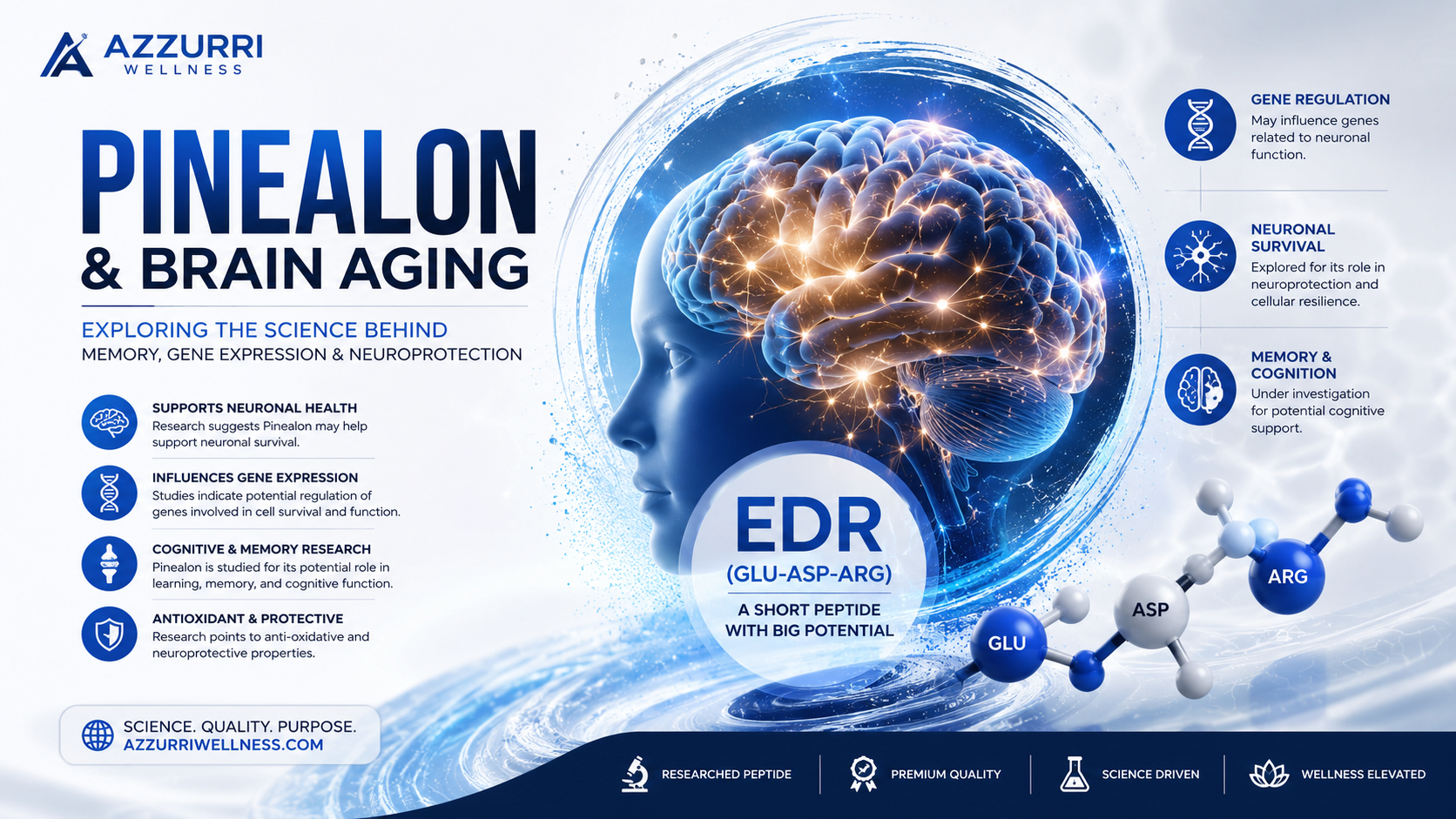
Pinealon and Brain Aging: What Research Examines About Gene Expression, Memory, and Neuroprotection
Pinealon has been studied in relation to brain aging, neuronal survival, gene expression, memory, oxidative stress, and cellular resilience.
What Is Pinealon?
Pinealon is a short tripeptide composed of glutamic acid, aspartic acid, and arginine, commonly written as Glu-Asp-Arg or EDR.
It has been investigated primarily in relation to neuronal function, age-related changes in the nervous system, gene regulation, and cellular resilience.
Researchers have described Pinealon as a neuroprotective peptide in experimental models, while published work has also examined possible effects on gene expression and neuronal survival.
However, much of the available evidence comes from laboratory and animal studies rather than large modern human trials.
Why Researchers Study Pinealon in Brain Aging
Brain aging involves more than memory loss. It includes changes in neuronal signaling, oxidative stress, protein expression, synaptic structure, and the ability of nerve cells to respond to damage.
Pinealon has attracted scientific interest because research suggests that short peptides may interact with some of these processes.
Cellular Regulation and Aging
Studies involving the EDR peptide have reported changes in gene expression related to neuronal function and cell survival.
This makes Pinealon relevant to research examining how small peptide signals may influence age-related changes at the cellular level.
Pinealon and Gene Expression
One of the most interesting areas of Pinealon research involves gene regulation.
Research examining the EDR peptide has reported that it may influence the expression of genes and proteins involved in maintaining neuronal function.
Possible Effects on Cell Survival
Researchers have also described effects related to apoptosis, the controlled process through which cells are removed when damaged or no longer functioning normally.
These findings suggest that Pinealon may interact with regulatory pathways inside neurons rather than acting through one simple receptor mechanism.
This does not mean Pinealon can directly “switch off aging.” Gene-expression changes are complex, and laboratory findings do not automatically translate into measurable clinical benefits.
Memory and Cognitive Research
Researchers have also examined Pinealon in relation to memory and cognitive function.
Research on short neuroprotective peptides has explored whether peptide-related changes in neuronal function could influence memory and cognition, particularly in older populations.
Limits of the Human Evidence
The human evidence remains limited and is not comparable in scale to the large randomized trials typically required to establish a therapy for cognitive decline.
It is therefore more accurate to describe Pinealon as an experimental peptide being studied in relation to cognition rather than as a proven memory-enhancing compound.
Pinealon and Neuronal Survival
Neuroprotection refers to biological processes that help neurons remain functional when exposed to stress or injury.
Pinealon has been investigated in several experimental models involving neurological stress.
Research Under Neurological Stress
Animal studies have examined Pinealon in conditions associated with developmental and metabolic stress affecting the nervous system.
Other experimental work has examined Pinealon under hypoxic conditions, where tissues receive reduced oxygen.
Researchers have reported increased neuronal resistance in some of these experimental models.
These findings are scientifically interesting, but they remain preclinical and cannot establish that Pinealon protects the human brain from neurological disease.
Dendritic Spines and Neural Communication
Neurons communicate through highly specialized structures, including dendritic spines.
These small projections play an important role in synaptic signaling, learning, and memory.
Potential Effects on Neuronal Structure
Research involving the EDR peptide has reported that Pinealon may influence the preservation of dendritic spines in experimental neuronal cultures.
This provides another possible mechanism through which Pinealon could influence neuronal connectivity.
However, preserving dendritic structures in laboratory cultures is not the same as proving improved cognition in people.
Pinealon and Oxidative Stress
Oxidative stress occurs when reactive molecules overwhelm the cell's ability to control them.
The nervous system can be particularly sensitive to oxidative damage because neurons have high metabolic demands.
Cellular Resilience Research
Research reviews have described Pinealon as influencing cellular viability, free-radical levels, and other processes related to cellular resilience in laboratory models.
This has contributed to interest in Pinealon as a peptide involved in cellular protection and neuronal regulation.
Antioxidant activity in laboratory research should not be interpreted as evidence that Pinealon can prevent age-related neurological disease.
What Human Evidence Exists?
Human evidence for Pinealon is considerably smaller than the preclinical evidence.
Reviews have discussed clinical use of short neuroprotective peptides, including Pinealon, in older adults and people with neurological conditions.
Why More Research Is Needed
Many of these studies come from a limited research tradition and lack the large, independently replicated randomized trials needed to establish broad clinical conclusions.
This remains an important limitation when discussing Pinealon and brain aging.
What Current Research Does Not Establish
Current evidence does not prove that Pinealon:
- Prevents dementia
- Reverses brain aging
- Reliably improves memory in healthy adults
- Increases intelligence or mental performance
- Prevents stroke or neurological disease
- Repairs damaged neurons in humans
- Produces predictable long-term cognitive benefits
Much of the strongest mechanistic evidence remains preclinical.
Final Takeaway
Pinealon is an interesting short peptide because research has connected it with several biological processes relevant to brain aging, including gene expression, neuronal survival, dendritic structure, oxidative stress, and cognitive function.
Laboratory and animal studies provide evidence of measurable biological activity, while some clinical literature has explored neuroprotective applications in older populations.
The evidence is not strong enough to establish Pinealon as a proven treatment for memory loss or age-related neurological decline.
Its current value lies primarily in helping researchers study how short peptide signals may influence neuronal regulation and resilience.