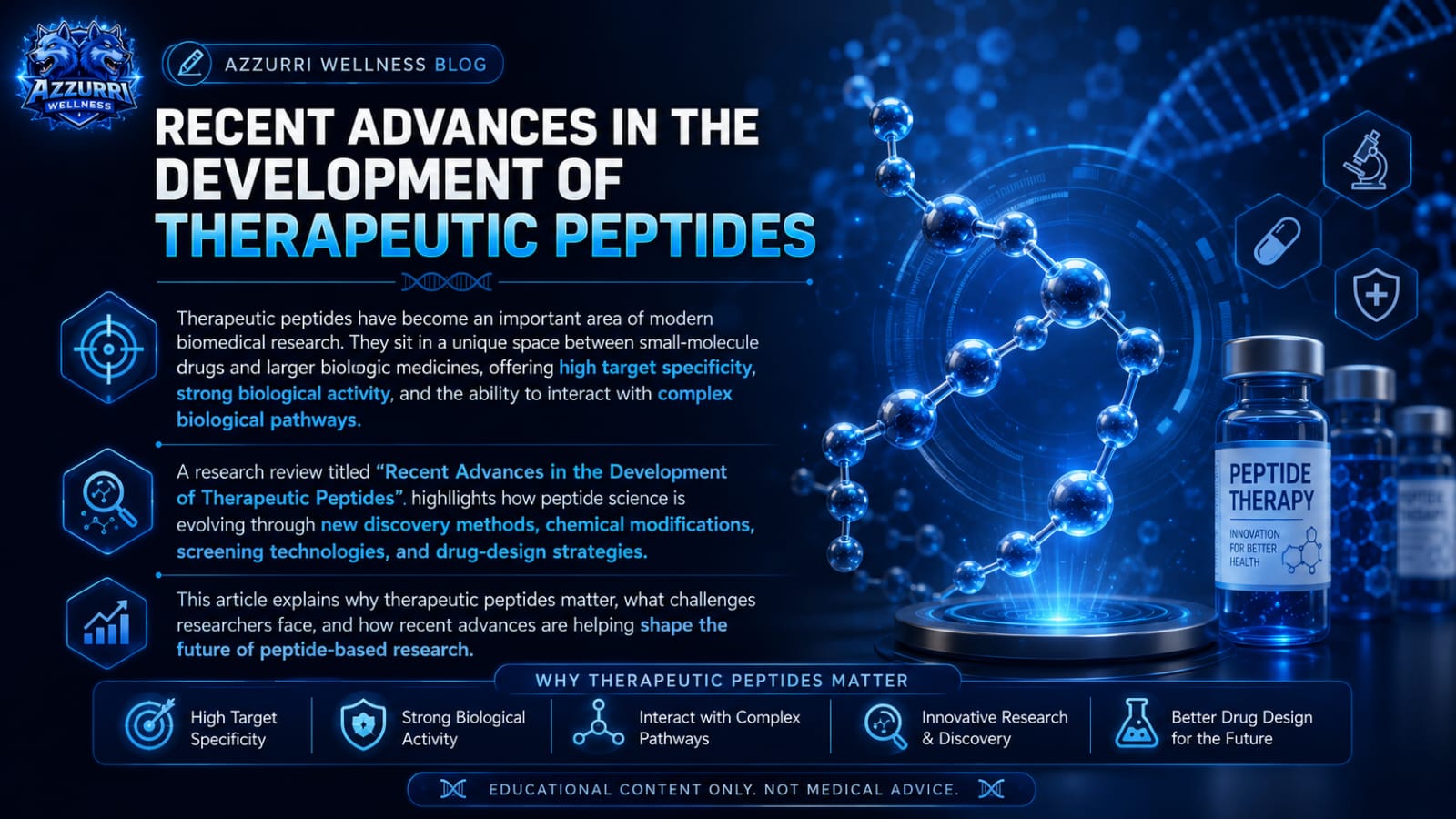
Therapeutic peptides have become an important area of modern biomedical research. They sit in a unique space between small-molecule drugs and larger biologic medicines, offering high target specificity, strong biological activity, and the ability to interact with complex biological pathways.
A research review titled "Recent Advances in the Development of Therapeutic Peptides" highlights how peptide science is evolving through new discovery methods, chemical modifications, screening technologies, and drug-design strategies.
This article explains why therapeutic peptides matter, what challenges researchers face, and how recent advances are helping shape the future of peptide-based research.
What Are Therapeutic Peptides?
Therapeutic peptides are short chains of amino acids designed or studied for biological activity. Like naturally occurring peptides in the body, they can interact with receptors, enzymes, proteins, or cell-signaling pathways.
Peptides are involved in many biological functions, including hormone signaling, immune regulation, metabolism, tissue communication, and cellular response.
Because of their ability to target specific biological systems, peptides have become valuable tools in research areas such as:
- Metabolic disorders
- Cancer biology
- Infectious disease research
- Immune system studies
- Neurological research
- Hormone signaling
- Drug-delivery science
Why Peptides Are Important in Drug Development
Peptides offer several characteristics that make them attractive in therapeutic research.
They can be highly selective, meaning they may interact with specific biological targets while avoiding unrelated pathways. They can also be designed to mimic natural signaling molecules, which makes them useful for studying how cells communicate and respond to biological signals.
Compared with many small molecules, peptides may offer stronger target specificity. Compared with larger biologics, peptides may be smaller, easier to modify, and more flexible for certain design strategies.
This balance has made peptides an active focus in modern drug discovery.
Key Challenges in Peptide Development
Although peptides have strong scientific potential, they also come with challenges.
Many natural peptides break down quickly in the body because enzymes can degrade them. Some peptides may have poor stability, limited absorption, short half-life, or difficulty reaching their target.
Common challenges include:
- Low stability
- Rapid enzymatic breakdown
- Short duration of action
- Poor membrane permeability
- Delivery limitations
- Manufacturing complexity
- Solubility issues
- Need for careful purification and testing
These limitations explain why peptide development often requires advanced design and modification strategies.
Chemical Modification of Peptides
One of the major advances discussed in peptide research is chemical modification.
Researchers use chemical modifications to improve peptide stability, increase half-life, strengthen receptor binding, or reduce breakdown by enzymes.
Examples of modification strategies include:
- Cyclization
- Substitution with D-amino acids
- N-terminal or C-terminal modification
- Lipidation
- Pegylation
- Stapled peptides
- Backbone modification
These strategies can help improve the therapeutic profile of peptide candidates and make them more suitable for research or clinical development.
Cyclization and Peptide Stability
Cyclization is a technique where a peptide is chemically linked into a ring-like structure.
This can help protect the peptide from enzymatic degradation and improve structural stability. A more stable structure can sometimes improve receptor binding or biological activity.
Cyclized peptides are especially interesting because their shape may help them interact more precisely with specific biological targets.
D-Amino Acid Substitution
Most natural peptides are made from L-amino acids. Researchers sometimes substitute certain positions with D-amino acids to make peptides more resistant to enzymatic breakdown.
Because many enzymes are designed to recognize natural L-amino acid sequences, D-amino acid substitution can help improve stability.
This is one example of how small molecular changes can significantly influence peptide behavior.
Peptide Discovery Technologies
Recent advances in peptide discovery have also changed how researchers identify promising peptide candidates.
Modern discovery methods include:
- Phage display
- mRNA display
- Ribosome display
- Synthetic peptide libraries
- Computational peptide design
- High-throughput screening
These technologies allow scientists to screen large numbers of peptide sequences and identify candidates with desired properties.
Instead of testing one molecule at a time, researchers can now explore vast peptide libraries more efficiently.
Computational Peptide Design
Computational tools are playing a growing role in peptide research.
Computer-assisted methods can help predict peptide structure, receptor binding, stability, solubility, and potential biological activity. These tools can support early-stage peptide design before laboratory testing begins.
As artificial intelligence and molecular modeling improve, computational peptide design may become even more important in discovering and optimizing future peptide candidates.
Peptides in Targeted Research
Therapeutic peptides are especially valuable because they can be designed for specific biological targets.
Researchers study peptide-based approaches in areas such as:
- Receptor activation
- Enzyme inhibition
- Protein-protein interaction disruption
- Targeted drug delivery
- Immune signaling
- Antimicrobial activity
- Cancer-targeting strategies
This makes peptides useful not only as potential therapeutics, but also as research tools for understanding biological pathways.
Peptide Delivery Systems
Delivery remains one of the biggest challenges in peptide development.
Because peptides can be broken down in the digestive system and may not easily cross certain biological barriers, researchers continue to study better delivery methods.
Delivery strategies may include:
- Injectable formulations
- Nanoparticle delivery
- Cell-penetrating peptides
- Lipid-based systems
- Depot formulations
- Oral delivery technologies
- Transdermal or mucosal delivery research
Improving delivery is a major part of making peptide-based research more practical and effective.
Why Quality and Documentation Matter
As peptide science advances, quality control becomes increasingly important.
Peptides are sequence-specific molecules. Their identity, purity, stability, and handling can influence research outcomes.
This is why peptide-related education often focuses on:
- Batch information
- Certificate of Analysis
- Purity testing
- Identity confirmation
- Storage instructions
- Stability data
- Clear documentation
A peptide is not defined only by its name. It is defined by its sequence, quality, testing, and handling.
The Future of Therapeutic Peptides
The future of therapeutic peptide research is promising because new technologies are helping solve old challenges.
Advances in peptide modification, delivery systems, discovery platforms, and computational design are expanding what peptides can do.
Researchers continue to explore peptides for metabolic disease, oncology, infectious disease, immune regulation, and other areas where targeted biological activity is important.
As the field grows, responsible education becomes essential. Peptide science should be discussed with clarity, evidence, and proper context.
Educational content only. Not medical advice.