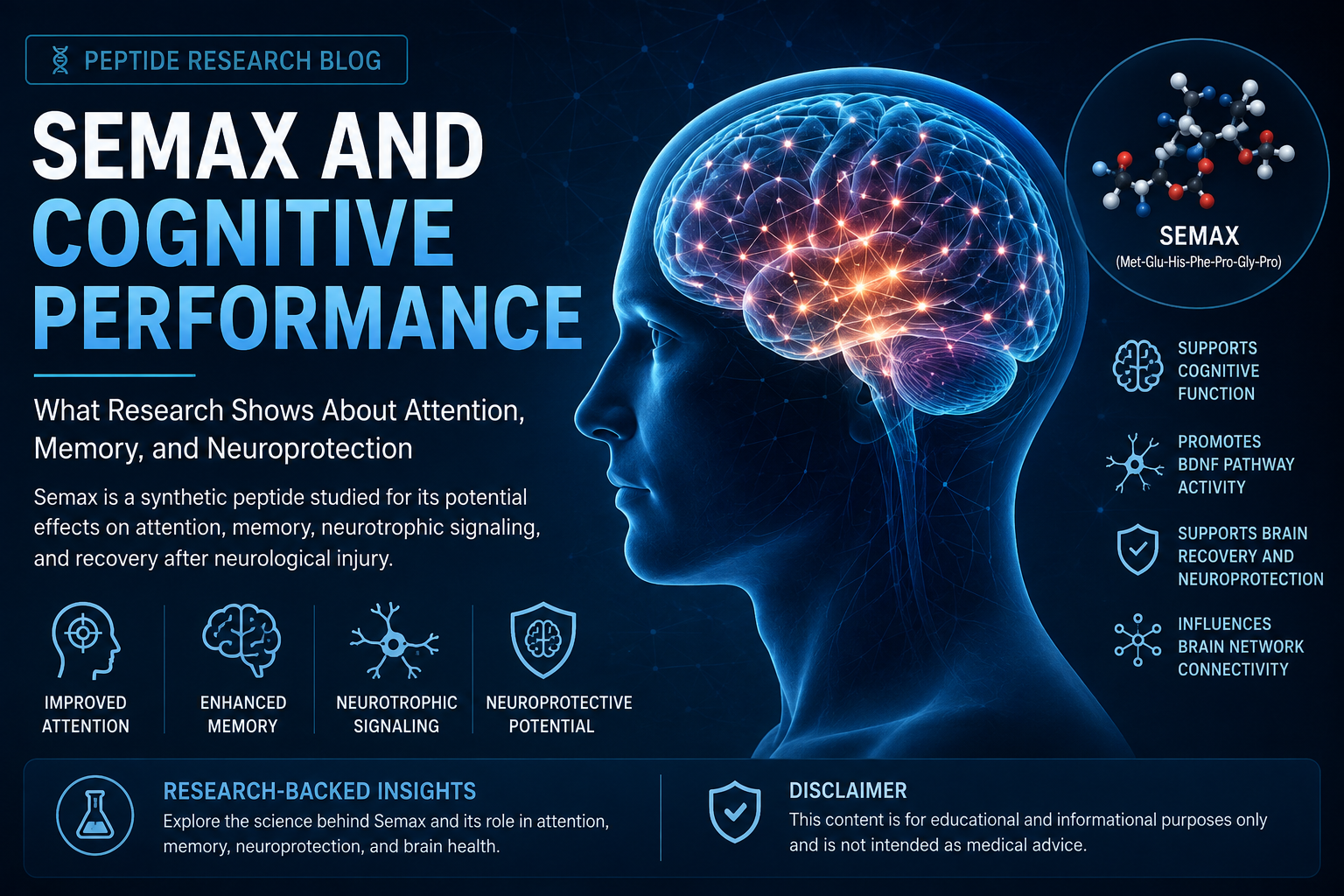
Semax and Cognitive Performance: What Research Shows About Attention, Memory, and Neuroprotection
Semax has been studied for possible effects on attention, memory, neurotrophic signaling, and neurological recovery, but much of the evidence remains limited or condition-specific.
Semax is a synthetic peptide derived from a fragment of adrenocorticotropic hormone, or ACTH. It has been studied for several decades because of its potential effects on attention, memory formation, neurotrophic signaling, and recovery after neurological injury.
Research has reported cognitive and neuroprotective effects in experimental models and some human studies. However, much of the evidence remains limited, regional, or focused on specific neurological conditions rather than healthy everyday cognitive performance.
What Is Semax?
Semax is a seven-amino-acid peptide with the sequence Met-Glu-His-Phe-Pro-Gly-Pro.
It was developed from the ACTH(4-10) region but was designed without the hormonal activity normally associated with ACTH.
Researchers became interested in Semax because experimental studies suggested that it could influence learning, memory, attention, and neuronal survival.
Early Human Research
An early human-focused study reported improvements in memory and attention among healthy men working under demanding conditions.
However, this research comes from older literature and does not provide the type of large, modern randomized evidence normally expected before making broad claims about cognitive enhancement.
Semax and Attention
Attention is not a single neurological process. It includes the ability to maintain focus, filter distractions, shift between tasks, and allocate mental resources.
Published research has described Semax as influencing selective attention and cognitive performance.
Reviews of its pharmacology have discussed findings involving attention and memory in both rodents and humans following intranasal administration.
Why the Evidence Requires Caution
Older studies often involved relatively small groups, specialized conditions, or experimental designs that differ from modern cognitive-performance trials.
As a result, findings involving attention should be considered scientifically interesting rather than proof of predictable cognitive improvement.
Memory and Learning Research
Semax has also been investigated in relation to memory formation and learning.
Experimental work suggests that some of its cognitive effects may involve changes in neurotrophic signaling, particularly the brain-derived neurotrophic factor, or BDNF, pathway.
The Role of BDNF
BDNF is involved in neuronal survival, synaptic plasticity, and the brain’s ability to adapt during learning.
A laboratory study found that Semax influenced the expression and activation of the hippocampal BDNF/TrkB system.
Researchers suggested that this pathway may contribute to some of the cognitive effects observed in experimental studies.
Other Neurotrophic Pathways
Animal research has also reported increases in BDNF and nerve growth factor-related signaling after Semax exposure.
These findings provide a possible biological explanation for observed learning and memory effects, but molecular changes in animals do not automatically establish meaningful cognitive improvement in humans.
Semax and Neuroprotection
Another major area of Semax research involves neuroprotection.
Animal models of cerebral ischemia have examined whether Semax alters inflammatory, vascular, and neuronal-survival pathways following reduced blood flow to the brain.
Experimental Findings
Research has reported changes in genes involved in:
- Vascular function
- Inflammatory signaling
- Neurotransmission
- Cell survival
- Neurological recovery
These findings suggest that Semax may influence multiple biological pathways during neurological stress.
Semax in Stroke Rehabilitation Research
Human research has also examined Semax during rehabilitation following ischemic stroke.
One study reported increased plasma BDNF levels and improved functional recovery when Semax was incorporated into an early rehabilitation program.
Why This Evidence Is Condition-Specific
These results apply to a specific clinical population recovering from stroke.
They should not be generalized to healthy individuals seeking improved memory, focus, productivity, or other forms of cognitive enhancement.
Brain Connectivity Research
Researchers have also used functional brain imaging to examine Semax.
One study involving healthy participants evaluated whole-brain resting-state functional connectivity after administration of Semax or Selank.
Areas Examined
The research included brain regions such as the dorsolateral prefrontal cortex, which is involved in executive functions including:
- Working memory
- Attention control
- Planning
- Decision-making
Studies of this type help scientists understand how peptide signaling may influence brain networks.
However, altered functional connectivity does not necessarily mean improved real-world memory, concentration, intelligence, or productivity.
What the Evidence Does Not Yet Establish
Current research does not prove that Semax:
- Reliably improves memory in healthy adults
- Prevents cognitive decline
- Treats dementia
- Produces consistent improvements in concentration
- Protects the brain from every form of neurological injury
- Improves productivity or intelligence
- Produces predictable long-term cognitive benefits
Much of the strongest mechanistic evidence comes from animal research, while the human evidence remains comparatively limited.
Final Takeaway
Semax is an interesting research peptide because it sits at the intersection of cognition, neurotrophic signaling, and neuroprotection.
Studies have explored its effects on attention, memory, BDNF signaling, brain connectivity, and neurological recovery.
The evidence suggests meaningful biological activity, but it is not strong enough to support broad claims that Semax reliably enhances cognitive performance in healthy people.
Its strongest current value lies in helping researchers investigate how peptide signaling may influence learning, neuronal plasticity, and brain recovery.
Research References
- Semax pharmacology and cognitive effects involving memory, attention, dopamine, and BDNF. View research
- Research on Semax and hippocampal BDNF/TrkB signaling. View research
- Human stroke rehabilitation research involving Semax and BDNF. View research
- Healthy-participant brain connectivity research involving Semax. View research
- Experimental research on Semax, neurotrophins, and ischemic brain injury. View research
- Early human research describing memory and attention effects under demanding conditions. View research