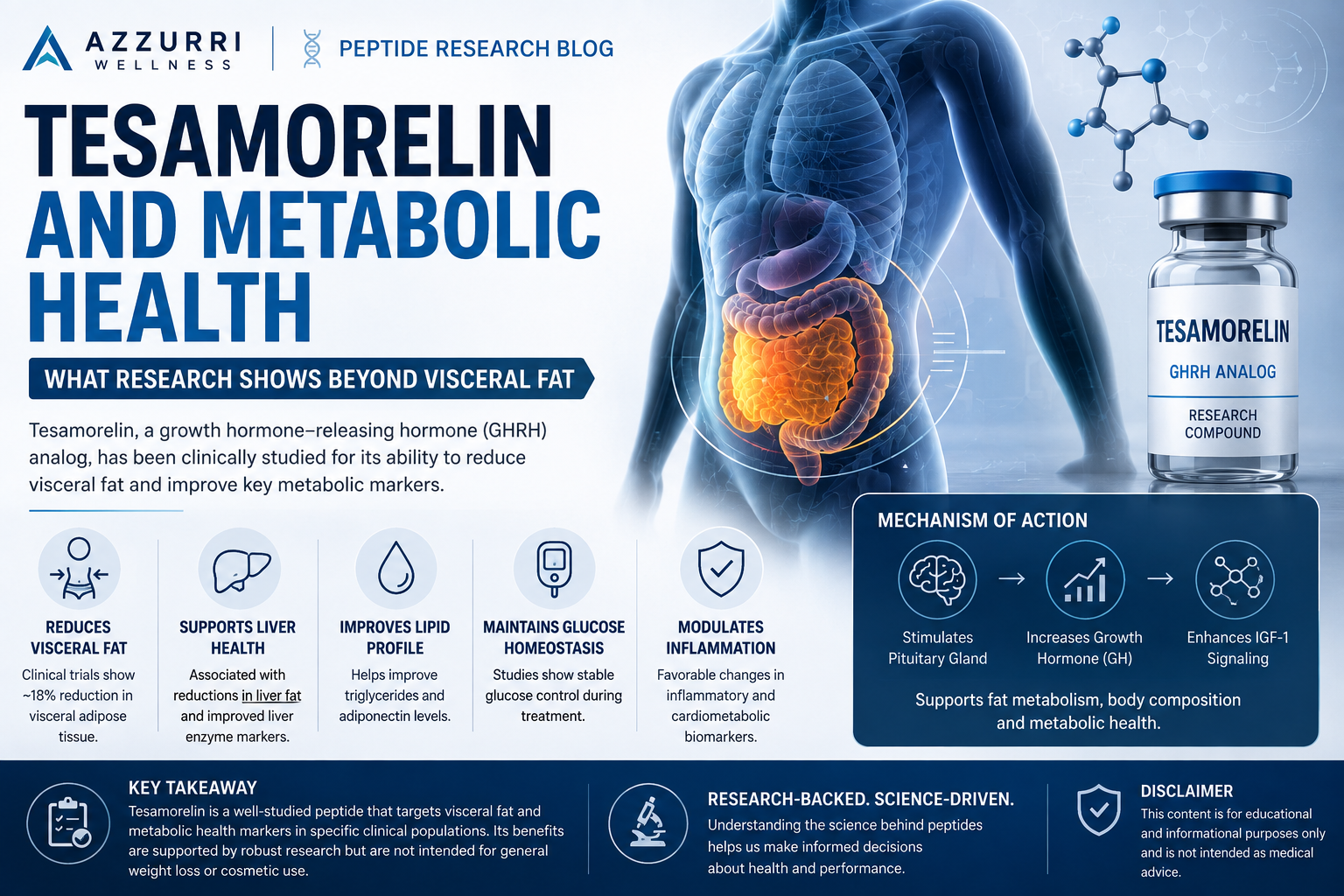
Tesamorelin and Metabolic Health: What Research Shows Beyond Visceral Fat
Tesamorelin has been studied primarily for excess visceral abdominal fat in adults with HIV-associated lipodystrophy, while additional research has examined liver fat, lipids, glucose regulation, and other metabolic outcomes.
Tesamorelin is a synthetic growth hormone-releasing hormone analogue studied primarily for reducing excess visceral abdominal fat in adults with HIV-associated lipodystrophy.
Clinical trials have shown measurable reductions in visceral adipose tissue, while additional research has examined liver fat, triglycerides, glucose regulation, inflammatory markers, and other metabolic outcomes.
The evidence is substantial for its specific clinical context, but it should not be generalized into a routine weight-loss or body-composition peptide for the broader population.
What Is Tesamorelin?
Tesamorelin is an analogue of growth hormone-releasing hormone, or GHRH.
Rather than acting as growth hormone itself, it stimulates the pituitary gland to increase endogenous growth hormone secretion.
The GH/IGF-1 Pathway
Increased growth hormone signaling can influence downstream insulin-like growth factor-1, or IGF-1.
This pathway may affect:
- Fat metabolism
- Body composition
- Energy regulation
- Metabolic signaling
Large randomized trials have studied tesamorelin in adults with HIV who developed excess abdominal fat while receiving antiretroviral therapy.
Visceral Fat Is Different From Body Weight
One of the most important distinctions in tesamorelin research is the difference between visceral fat and overall body weight.
Visceral adipose tissue surrounds internal organs within the abdominal cavity. It is metabolically different from subcutaneous fat stored beneath the skin.
Visceral Fat Reduction in Clinical Trials
Clinical trials have found that tesamorelin can selectively reduce visceral fat in people with HIV-associated abdominal adiposity.
A pooled analysis of phase III studies reported visceral-fat reductions of approximately 18% among treated participants.
This does not mean tesamorelin functions as a conventional weight-loss drug. Changes in visceral fat can occur without large changes in total body weight.
Tesamorelin and Liver Fat
Researchers have also examined whether reducing visceral fat affects fat stored in the liver.
A randomized study involving people with HIV and abdominal fat accumulation found that six months of tesamorelin was associated with reductions in visceral fat and modest reductions in liver fat.
Why Liver Fat Matters
Visceral adiposity and liver fat often occur alongside metabolic dysfunction.
This makes liver-fat research particularly relevant when studying the broader metabolic effects of interventions that influence body composition.
However, researchers emphasized that additional studies were needed to determine the clinical significance and long-term consequences of these changes.
Lipids and Metabolic Markers
Tesamorelin research has also examined triglycerides and other cardiometabolic markers.
Triglycerides and Lipid Profiles
A randomized trial found that tesamorelin reduced visceral fat and improved lipid profiles in people with HIV-associated central fat accumulation.
Adiponectin and Glucose Homeostasis
Another analysis found that participants who achieved a meaningful reduction in visceral adipose tissue also experienced improvements in triglycerides and adiponectin while generally maintaining glucose homeostasis over the study period.
These findings suggest that changes in visceral fat may be associated with broader metabolic changes, but not every participant responds in the same way.
Liver Enzymes and Visceral Fat Reduction
Further research has examined whether reductions in visceral fat correspond with changes in liver-related laboratory markers.
An analysis of clinical trial participants found that significant visceral-fat reduction during tesamorelin treatment was associated with improvements in liver enzymes among participants with abdominal obesity and elevated baseline transaminases.
What This Does Not Prove
This association does not prove that tesamorelin directly treats liver disease.
It does, however, contribute to research examining how visceral adiposity, growth-hormone signaling, and liver metabolism may interact.
What About Glucose Regulation?
Growth hormone pathways can affect glucose metabolism, so researchers have monitored glucose carefully in tesamorelin trials.
Some major studies reported meaningful visceral-fat reduction without significant deterioration in glucose measurements at the group level.
Individual Responses Can Differ
Metabolic responses can differ between individuals, and glucose-related safety remains clinically important when influencing the GH/IGF-1 axis.
This is another reason tesamorelin research should not be simplified into a general “fat-loss peptide” narrative.
Tesamorelin and Inflammatory Markers
Researchers have also explored whether tesamorelin influences biomarkers associated with inflammation and cardiovascular risk.
Markers Examined in Clinical Research
Studies have measured markers including:
- C-reactive protein
- Adiponectin
- PAI-1
- Tissue plasminogen activator
These studies help scientists examine whether changing visceral adiposity may influence broader metabolic and inflammatory pathways.
They do not establish that tesamorelin prevents cardiovascular disease.
What Happens When Treatment Stops?
Longer-term research found that continued treatment was important for maintaining reductions in visceral fat.
Participants who stopped tesamorelin after an initial treatment period tended to regain some of the visceral fat that had been lost.
Participants who continued treatment maintained more of the reduction.
What This Shows About Metabolic Signaling
This illustrates an important principle in metabolic research: changing a biological pathway may produce effects while that pathway is being influenced, but those effects may not remain indefinitely after treatment stops.
What the Research Does Not Prove
Current evidence does not establish tesamorelin as:
- A general obesity treatment
- A routine weight-loss peptide
- A substitute for nutrition and physical activity
- A universal treatment for fatty liver disease
- A bodybuilding or athletic-performance compound
- A guaranteed method for reducing abdominal fat in healthy adults
- An appropriate treatment outside its established clinical context
Most of the strongest evidence comes specifically from adults with HIV-associated lipodystrophy.
Final Takeaway
Tesamorelin is one of the better-studied peptide-related therapies affecting body composition, but its research context matters.
Randomized human trials show reductions in visceral abdominal fat among people with HIV-associated lipodystrophy.
Additional studies have explored changes in liver fat, triglycerides, adiponectin, liver enzymes, and other metabolic markers.
These findings make tesamorelin an important tool for studying the relationship between growth-hormone signaling and metabolic health.
They do not mean that its effects can automatically be assumed for general weight loss or wellness use.
Research References
- Large randomized phase III study examining tesamorelin and abdominal fat in adults with HIV. View research
- Phase III analysis reporting visceral-fat reduction and metabolic outcomes. View research
- Randomized human study examining visceral fat and liver fat. View research
- Research examining triglycerides, adiponectin, and glucose homeostasis in tesamorelin responders. View research
- Analysis linking visceral-fat reduction with changes in liver enzymes. View research
- Randomized trial examining inflammatory and cardiovascular biomarkers. View research
- Longer-term research examining maintenance of visceral-fat reduction during continued treatment. View research