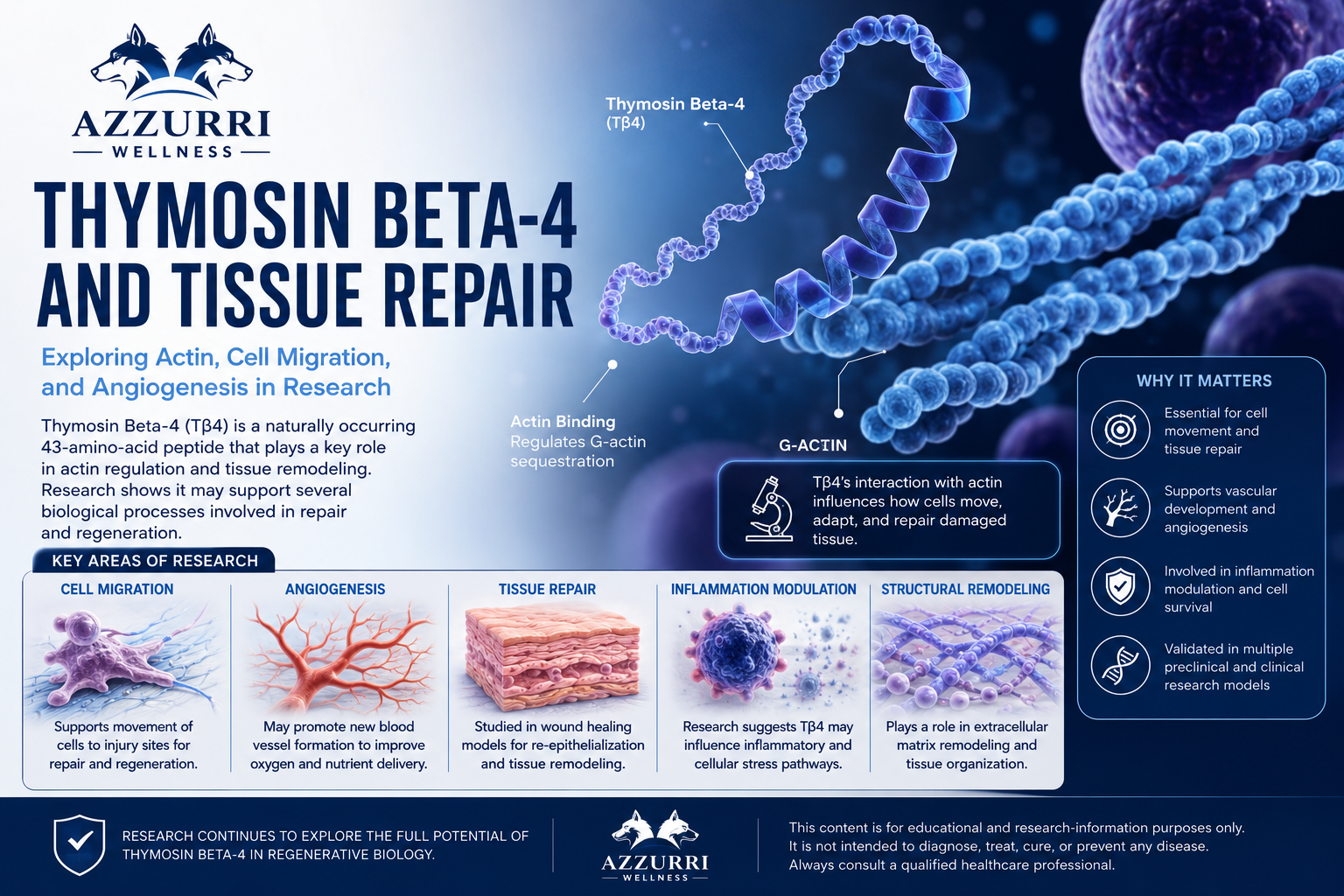
Thymosin Beta-4 and Tissue Repair: What Research Shows About Actin, Cell Migration, and Angiogenesis
Thymosin Beta-4 has been studied in relation to actin regulation, cell migration, angiogenesis, inflammation, and tissue-remodeling mechanisms.
What Is Thymosin Beta-4?
Thymosin Beta-4, commonly abbreviated as Tβ4, is a naturally occurring 43-amino-acid peptide found widely throughout the body.
One of its best-established molecular functions is binding to G-actin, the free form of actin used by cells to build and reorganize their internal structural framework.
Because actin dynamics influence cell movement, shape, adhesion, and repair, researchers have investigated Tβ4 across a broad range of tissue-remodeling models.
Scientific research describes Tβ4 as an important actin-sequestering molecule with possible roles in tissue development, maintenance, and repair.
Why Actin Matters in Tissue Repair
Actin is one of the most important structural proteins inside cells.
Rather than forming a fixed skeleton, the actin network constantly reorganizes as cells move, divide, change shape, and respond to injury.
Processes Influenced by Actin Dynamics
During tissue repair, cells may need to:
- Migrate toward damaged areas
- Attach to surrounding tissue
- Remodel extracellular structures
- Form new blood vessels
- Restore protective tissue barriers
Tβ4 has attracted scientific interest because its interaction with actin may influence several of these processes.
Thymosin Beta-4 and Cell Migration
Cell migration is a fundamental part of tissue repair.
When tissue is damaged, different types of cells must move toward the affected area. Fibroblasts, endothelial cells, epithelial cells, and immune cells may all participate during different phases of the repair response.
Experimental research has found that Tβ4 can influence cell migration in several tissue models.
The Actin-Binding Region
Research examining Tβ4 and shorter peptide fragments found that a seven-amino-acid sequence associated with actin binding was important for some of its angiogenic activity.
This suggests that the interaction between Tβ4 and actin may contribute to the way cells move and reorganize during tissue remodeling.
Why Cell Migration Is Important
Efficient cell migration contributes to several biological processes involved in repair.
- Surface re-epithelialization
- Vascular development
- Extracellular-matrix remodeling
- Tissue organization
- Closure of damaged areas
These mechanisms help explain why Tβ4 has become a frequent subject in regenerative-biology research.
Research Into Wound-Related Repair
Some of the earlier Tβ4 tissue-repair research focused on experimental wound models.
In animal studies, researchers reported changes involving re-epithelialization and wound contraction after administration of Tβ4 compared with control conditions.
Additional research has investigated Tβ4 in both experimental tissue models and human dermal-healing settings.
Why the Research Context Matters
These findings are scientifically useful because they show that Tβ4 can interact with several components of the repair process.
However, wound-healing findings should not automatically be generalized to sports injuries, muscle recovery, tendon damage, or every other type of tissue injury.
Different tissues repair themselves through different biological mechanisms.
Angiogenesis: Building New Blood Vessels
Another major area of Tβ4 research involves angiogenesis, the formation of new blood vessels.
Blood vessels deliver oxygen and nutrients to tissues, making vascular development an important component of many repair processes.
Research has described Tβ4 as influencing endothelial-cell behavior and new-vessel formation in experimental models.
Why Angiogenesis Matters During Repair
Damaged or regenerating tissue may require additional blood supply.
New vascular growth can contribute to:
- Oxygen delivery
- Nutrient transport
- Removal of metabolic waste
- Cellular migration
- Remodeling of injured tissue
For this reason, Tβ4 research has expanded beyond skin models into vascular, cardiovascular, and ischemia-related research.
Tβ4 and the Vascular System
Scientists have investigated Tβ4 in relation to vascular development and endothelial function.
Experimental research describes Tβ4 as an actin-binding peptide involved in vascular development and neovascularization.
Endothelial-Cell Research
Studies have examined several aspects of endothelial-cell biology, including:
- Cell viability
- Cellular senescence
- Mitochondrial function
- Angiogenic capacity
- Responses to metabolic stress
These findings help researchers understand how peptide signaling may influence vascular repair mechanisms.
They do not establish Tβ4 as a treatment for cardiovascular disease.
Inflammation and Tissue Remodeling
Tissue repair requires inflammation, but excessive or prolonged inflammatory activity can interfere with normal regeneration.
Tβ4 has therefore been investigated for possible effects on inflammatory and cellular-stress pathways.
Areas Examined in Experimental Research
- Inflammatory signaling
- Oxidative stress
- Cell-survival pathways
- Tissue remodeling
- Migration of repair-related cells
Rather than acting through one simple biological mechanism, Tβ4 appears to interact with several systems involved in structural remodeling and cellular responses to injury.
Is Thymosin Beta-4 the Same as TB-500?
Thymosin Beta-4 and TB-500 are frequently discussed together, but the terminology can become confusing.
Thymosin Beta-4 is the naturally occurring 43-amino-acid peptide studied extensively in the scientific literature.
Commercial or experimental materials described as TB-500 may be discussed in relation to Tβ4, but findings from published Tβ4 studies should not automatically be assumed to apply to every product marketed under another name.
For scientific accuracy, findings should be attributed to the exact peptide, formulation, and experimental model used in each study.
What the Research Does Not Establish
Current research does not prove that Thymosin Beta-4:
- Rapidly heals sports injuries in humans
- Regenerates torn tendons or ligaments
- Guarantees faster muscle recovery
- Eliminates inflammation
- Repairs every type of damaged tissue
- Improves athletic performance
- Prevents injury
- Produces the same results through every delivery method
Much of the mechanistic evidence comes from cellular and animal research, while human evidence varies considerably depending on the tissue and application being studied.
Why Tβ4 Remains Scientifically Interesting
Thymosin Beta-4 stands out because it connects several important areas of cell biology.
Its interaction with actin provides a plausible link to cell movement and structural remodeling.
Its effects on endothelial cells connect it with vascular research, while experimental findings involving inflammation and cellular survival broaden its scientific relevance.
This makes Tβ4 useful for studying how tissues coordinate multiple biological processes during repair.
Final Takeaway
Thymosin Beta-4 is a naturally occurring peptide with a well-established relationship to actin biology.
Research has examined its effects on cell migration, angiogenesis, endothelial function, inflammation, and wound-related tissue remodeling.
Experimental findings suggest meaningful biological activity across several repair-related pathways, but they should not be interpreted as proof that Tβ4 can reliably accelerate injury recovery or regenerate damaged tissues in humans.
Its current scientific value lies in understanding how actin dynamics, cellular migration, vascular development, and inflammatory signaling interact during tissue repair.