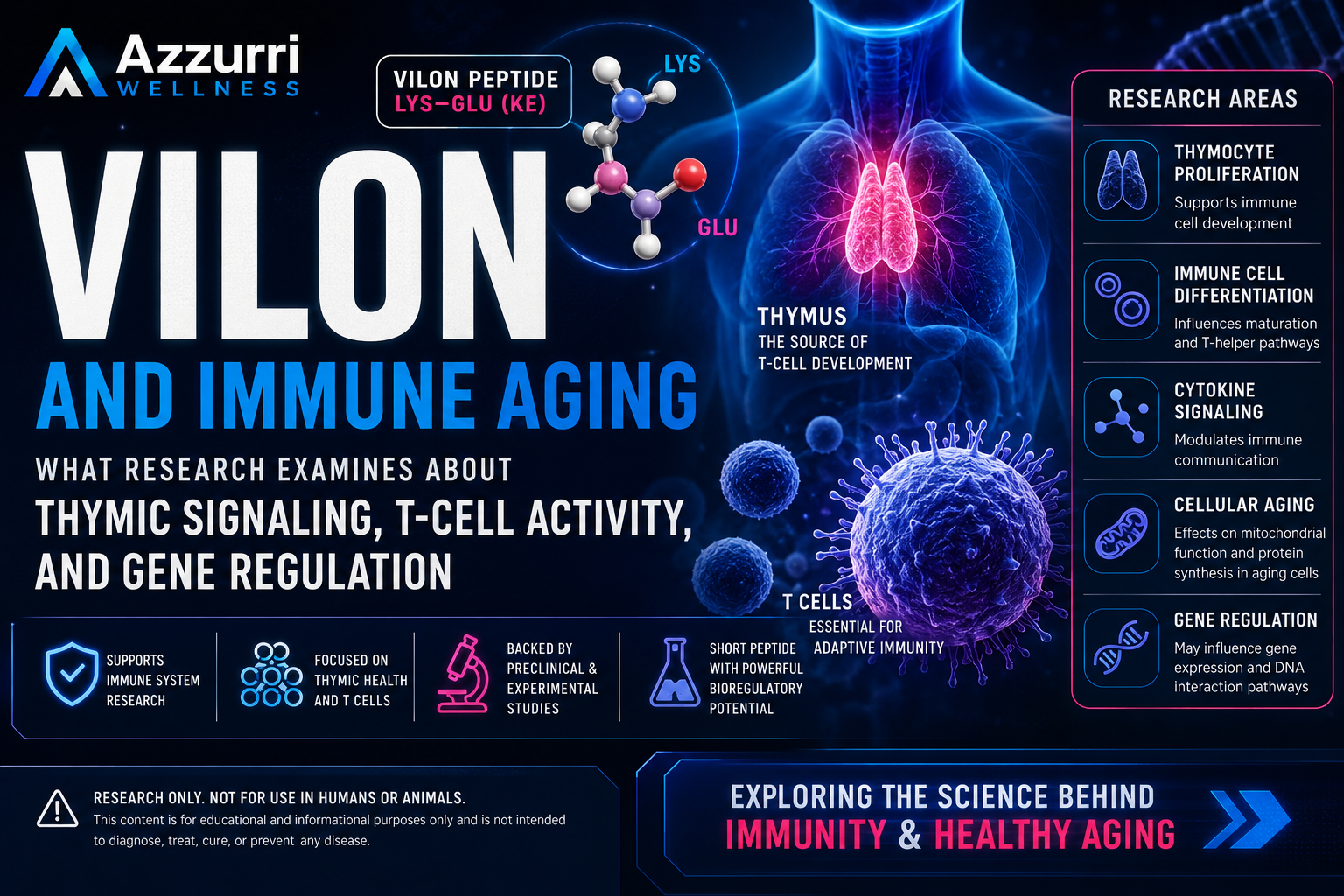
Vilon and Immune Aging: What Research Examines About Thymic Signaling, T-Cell Activity, and Gene Regulation
Vilon has been studied in relation to thymic signaling, immune-cell activity, cellular aging, gene regulation, and short-peptide bioregulation.
What Is Vilon?
Vilon is a very short synthetic peptide composed of the amino acids lysine and glutamic acid, commonly represented as Lys-Glu or KE.
It has been investigated primarily within the field of short peptide bioregulators, particularly for its possible effects on thymic cells, immune signaling, cellular differentiation, and age-related changes in biological regulation.
One reason Vilon attracts scientific interest is its simplicity. With only two amino acids, it provides researchers with a compact model for studying how short peptide sequences may influence cellular behavior.
The evidence base, however, is concentrated largely in experimental and preclinical research rather than large contemporary human clinical trials.
Why Researchers Study the Thymus During Aging
The thymus plays an important role in the development and selection of T cells.
T cells are essential components of adaptive immunity, but thymic structure and activity change substantially with age.
Thymic Involution and Immune Aging
The age-related reduction in thymic size and activity is commonly known as thymic involution.
Researchers study this process because it may influence the production, maturation, and diversity of T cells over time.
Vilon has been investigated in this context because experimental studies suggest that it can influence thymocytes, the developing immune cells found inside the thymus.
Vilon and Thymocyte Proliferation
Experimental research has examined how Vilon affects the proliferation of thymocytes.
In one study comparing several short peptides, researchers reported that Vilon produced a pronounced comitogenic effect on thymocyte proliferation and modified activity associated with interleukin-1β signaling.
Why Thymocyte Proliferation Matters
Thymocytes are immature T cells undergoing development inside the thymus.
Studying how these cells proliferate and differentiate can help researchers understand several aspects of immune biology, including:
- T-cell development
- Immune-cell maturation
- Age-related thymic changes
- Cytokine signaling
- Cellular responses to regulatory peptides
These findings demonstrate biological activity in an experimental model, but they do not establish that Vilon restores immune function in humans.
Vilon and Immune-Cell Differentiation
Research involving the KE peptide has also explored whether short peptide signals can influence how thymic cells differentiate.
Published research has described changes in markers associated with thymocyte maturation and T-helper-cell differentiation after exposure to Vilon.
Why Differentiation Is Important
Immune aging is not simply about the total number of immune cells present.
The quality, diversity, maturity, and function of those cells also matter.
These mechanistic findings are scientifically interesting, but they do not prove that Vilon can rebuild or restore an aged immune system.
Cytokine Signaling and Immune Regulation
Immune cells communicate using signaling proteins known as cytokines.
Research involving Vilon has examined interactions with interleukin-1β, an inflammatory signaling molecule involved in several aspects of immune-cell activation and regulation.
Regulation Rather Than Simple Stimulation
Experimental findings suggest that Vilon may alter how immune cells respond to specific signaling pathways.
This distinction is important because healthy immune function depends on coordinated regulation rather than simply increasing immune activity.
Vilon and Cellular Aging
Researchers have also examined the KE peptide in experimental models of cellular senescence.
Studies involving aging thymic and pineal cells have reported changes in mitochondrial activity and ribosomal protein synthesis following exposure to short peptides including Vilon.
Why Cellular Senescence Matters
Cellular senescence occurs when cells stop dividing but remain biologically active.
Senescent cells can undergo major changes involving:
- Metabolism
- Protein synthesis
- Mitochondrial activity
- Stress signaling
- Gene expression
Because these processes change with age, researchers are interested in whether short peptides can influence some of the molecular pathways involved.
These findings remain experimental and do not demonstrate that Vilon slows human aging.
Vilon and Gene Regulation
Another area of research involves the possibility that very short peptides may interact with processes controlling gene expression.
Vilon has been included in research examining short-peptide interactions with DNA and gene-regulatory mechanisms.
Why Gene Expression Matters
Gene expression helps determine which proteins a cell produces and how that cell responds to biological and environmental signals.
Changes in gene regulation can influence cellular function, differentiation, stress responses, and aging-related processes.
However, gene-regulatory activity should not be interpreted as a simple ability to “switch on youthful genes.”
Gene expression is highly complex and depends on tissue type, cellular state, and many interacting biological systems.
Immune Aging Is More Complicated Than One Peptide
Age-related changes in immunity involve many systems at once.
These include:
- Thymic involution
- Reduced production of naïve T cells
- Changes in T-cell diversity
- Altered inflammatory signaling
- Changes in cellular metabolism
- Accumulation of senescent cells
No single pathway completely explains immune aging.
Vilon is therefore most useful scientifically as a model for studying specific thymic, immune, and cellular-regulation mechanisms.
What Current Research Does Not Establish
Current evidence does not prove that Vilon:
- Reverses immune aging
- Restores a youthful thymus in humans
- Prevents infections
- Treats immune deficiency
- Improves vaccine responses
- Prevents cancer
- Extends human lifespan
- Reliably increases T-cell function in healthy adults
- Produces predictable long-term immune benefits
Much of the published evidence involves cells, animals, older regional literature, or mechanistic research rather than large independently replicated human trials.
Final Takeaway
Vilon is an unusually short peptide that has attracted interest because of its reported activity in thymic cells and other experimental models.
Research has explored its relationship with thymocyte proliferation, immune signaling, cellular differentiation, mitochondrial changes, and gene regulation.
These findings make Vilon an interesting research tool for understanding how very small peptide signals may interact with immune and aging-related pathways.
The evidence does not establish Vilon as a proven therapy for immune aging or immune-system restoration.