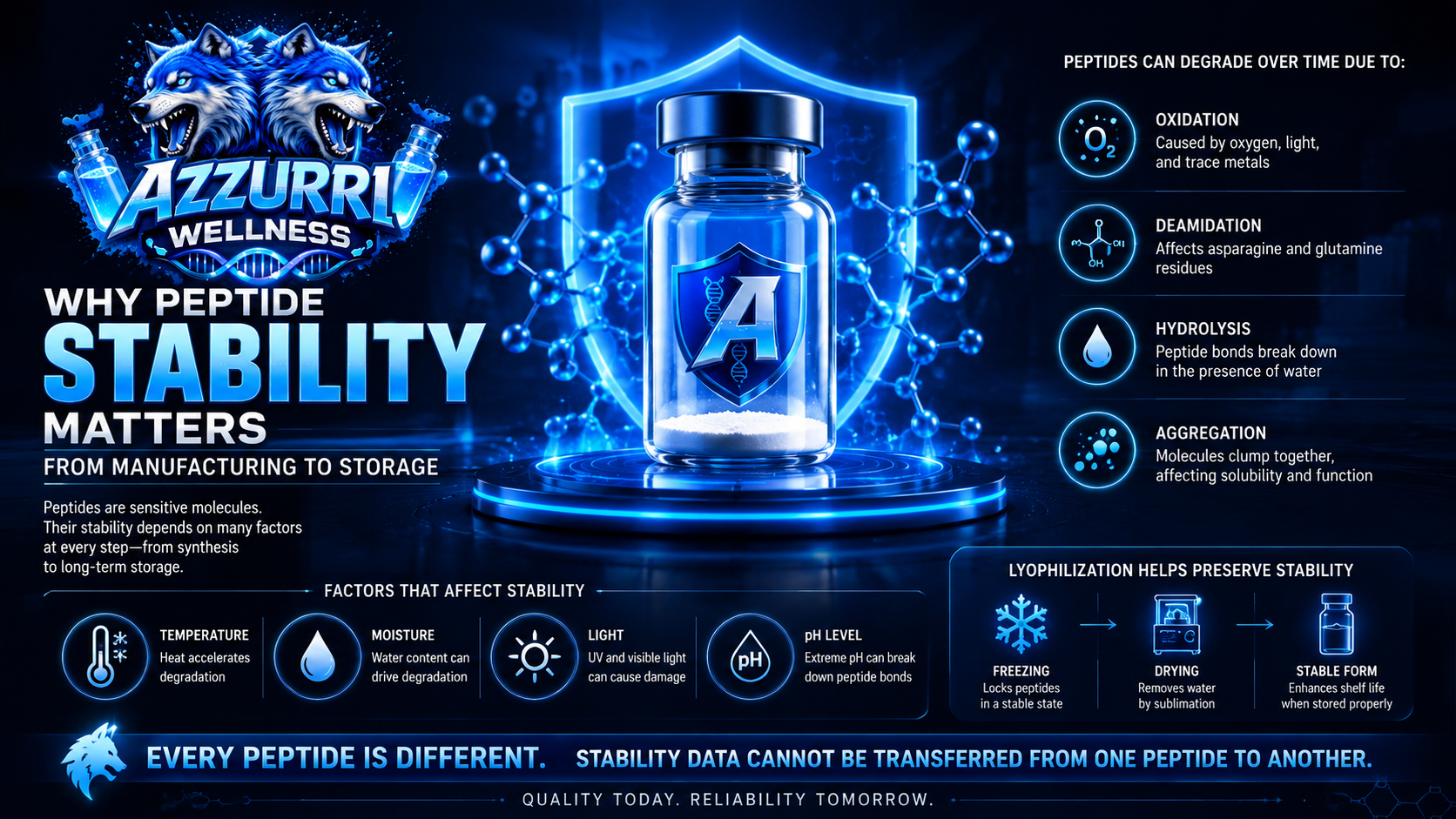
Peptide quality is not determined only at the moment synthesis is completed. A peptide may continue to change during purification, drying, packaging, transportation, storage, and laboratory handling.
Some of these changes are chemical, meaning the peptide’s molecular structure is altered. Others are physical, such as aggregation or precipitation. Either type can change the identity, purity, solubility, analytical profile, or research suitability of the material.
International stability guidance describes stability testing as the process of determining how product quality changes over time under environmental influences such as temperature, humidity, and light. These studies are used to establish supported shelf lives, retest periods, packaging requirements, and recommended storage conditions.
The central principle is simple:
A peptide is stable only under the specific conditions demonstrated by appropriate data.
A storage instruction should therefore be based on the individual peptide, formulation, container, and supporting stability study—not copied from a different product.
What does peptide stability mean?
Peptide stability describes the ability of a peptide material to remain within defined quality specifications over a stated period under specified conditions.
Those specifications may include:
Chemical identity Chromatographic purity Peptide content Molecular mass Impurity levels Physical appearance Solubility Moisture content Aggregation level Biological activity, when relevant to the research purpose
Stability is not a single measurement. A sample can retain its visual appearance while undergoing chemical degradation, or maintain a strong main HPLC peak while developing an impurity that requires more specific analysis.
Formal stability programs therefore evaluate attributes that are susceptible to change during storage and use analytical methods capable of separating or detecting relevant degradation products. ICH guidance also recommends stress testing with heat, humidity, oxidation, photolysis, and hydrolysis across different pH conditions to identify likely degradation pathways.
Chemical and physical degradation are different Chemical degradation
Chemical degradation changes the covalent structure of the peptide molecule. Important pathways include:
Oxidation Deamidation Hydrolysis or peptide-bond cleavage Aspartate isomerization Disulfide rearrangement Racemization Cyclization Covalent dimer formation Physical degradation
Physical degradation changes the condition or organization of peptide molecules without necessarily changing every molecule’s primary chemical formula.
Common examples include:
Aggregation Fibril formation Precipitation Adsorption to container surfaces Loss of solubility Changes in solid-state structure
The two categories can also interact. Chemical oxidation may make a peptide more likely to aggregate, while aggregation can change how residues are exposed to water, oxygen, or light. Research on oxidized recombinant human growth hormone, for example, found that methionine oxidation affected its aggregation behaviour during accelerated stability testing.
Major chemical degradation pathways 1. Oxidation
Oxidation occurs when susceptible amino-acid residues react with oxygen or reactive chemical species. Methionine is a frequently studied oxidation-sensitive residue, although tryptophan, cysteine, histidine, and tyrosine may also be vulnerable under certain conditions.
Oxidation risk can be influenced by:
Dissolved oxygen Light exposure Trace metal contamination Peroxides Buffer composition Formulation excipients Manufacturing equipment Container headspace Temperature
In a study of human insulin-like growth factor I, Fransson and Hagman found that methionine oxidation in aqueous solution was significantly influenced by visible light and formulation conditions, including phosphate. This demonstrates that oxidation cannot be predicted from the amino-acid sequence alone; the surrounding environment also matters.
The practical consequence of oxidation is molecule-dependent. In one gastrin-receptor-targeting peptide, oxidation of a methionine residue substantially reduced receptor affinity. Researchers had to evaluate pH, packaging components, buffer conditions, temperature, and manufacturing procedures when developing a stable formulation.
This does not mean every methionine-containing peptide will degrade at the same rate. The residue’s position, solvent exposure, nearby amino acids, conformation, formulation, and environmental stress all influence susceptibility.
- Deamidation
Deamidation most commonly affects asparagine and, through related pathways, glutamine residues. It can create products such as aspartate, isoaspartate, or intermediate cyclic structures.
Although the mass change may be small, deamidation can alter:
Molecular charge HPLC retention Conformation Receptor interaction Enzymatic susceptibility Aggregation behaviour
Deamidation is strongly influenced by the local amino-acid sequence. Neighbouring residues can accelerate or slow formation of degradation products, and different asparagine positions within the same peptide may behave differently.
Research on human growth hormone-releasing factor showed that degradation of aspartic-acid and asparagine residues varied with pH and temperature and produced multiple structurally related degradation products.
Deamidation can also occur in dried products. In a model asparagine-containing peptide, increasing moisture and glycerol content increased the deamidation rate in lyophilized polymer matrices. The study linked degradation to both water-related effects and increased molecular mobility within the solid formulation.
A freeze-dried appearance therefore does not guarantee complete chemical inactivity.
- Hydrolysis and peptide-bond cleavage
Hydrolysis involves reaction with water and may break a peptide bond, an ester linkage, or another susceptible chemical group.
It can be promoted by:
Strongly acidic conditions Strongly alkaline conditions Elevated temperature Specific sequence motifs Buffer catalysis Extended exposure to water
Hydrolysis does not affect every bond equally. Local sequence, terminal residues, structural flexibility, and surrounding formulation conditions can make certain positions more susceptible.
A study of model peptides containing a proline-related sequence showed pronounced pH dependence. The degradation product was relatively stable within one pH range but underwent hydrolysis under more acidic and more alkaline conditions. Altering the amino acid preceding proline also significantly changed the reaction rate.
This illustrates two important principles:
Peptide stability may change sharply across different pH environments. A small sequence change can produce a different degradation profile. 4. Aspartate-related degradation and isomerization
Aspartic acid and asparagine can form cyclic succinimide intermediates under certain conditions. These may convert into aspartate or isoaspartate-containing products.
The result may have nearly the same overall molecular mass as the original peptide while differing structurally. Ordinary intact-mass testing may therefore be insufficient to detect or fully characterize every isomeric degradation product.
Solid-state research on an aspartyl-containing model hexapeptide found that degradation in lyophilized formulations depended on formulation composition, residual moisture, and temperature.
This is one reason stability analysis may require a combination of:
Stability-indicating HPLC High-resolution mass spectrometry MS/MS Peptide mapping Specialized separation methods Physical instability and aggregation What is peptide aggregation?
Aggregation occurs when peptide molecules associate with one another to form dimers, oligomers, amorphous particles, or ordered fibrils.
Aggregation can be influenced by:
Amino-acid sequence Peptide concentration Temperature pH Ionic strength Agitation Interfaces Freeze–thaw cycles Oxidation Container materials
The resulting aggregates may be soluble or insoluble. Some are visible as cloudiness or particles, while others require analytical techniques such as size-exclusion chromatography, light scattering, microscopy, or spectroscopy.
An experimental comparison of bovine and human insulin A-chain fragments examined the effects of sequence, temperature, pH, ionic strength, urea, and stirring on fibril formation. The findings showed that relatively small differences in primary structure could influence aggregation behaviour.
That study reinforces a major stability rule:
Physical-stability behaviour cannot be assumed to be identical even for closely related peptide sequences.
Why agitation and interfaces matter
Peptide molecules may interact with air–liquid interfaces, vial walls, filters, tubing, or other processing surfaces. Shaking and stirring repeatedly expose molecules to these interfaces and can promote unfolding, association, or particle formation in susceptible products.
Manufacturing and laboratory handling therefore matter alongside long-term storage. A product that is stable while undisturbed may respond differently after vigorous mixing, repeated transfer, freeze–thaw cycles, or prolonged exposure to a partially filled container.
The need to evaluate handling conditions is peptide-specific. General advice such as “never shake any peptide” or “all peptides tolerate mixing” is scientifically too broad without product-specific evidence.
Environmental factors affecting peptide stability Temperature
Higher temperatures commonly increase the rates of chemical reactions, including oxidation, deamidation, and hydrolysis. Temperature can also change solubility, conformation, molecular movement, and aggregation kinetics.
However, accelerated-temperature data must be interpreted carefully. ICH guidance notes that accelerated testing can support evaluation of longer-term chemical effects and temporary storage excursions, but it may not reliably predict every physical change.
In lyophilized insulin, researchers observed temperature-dependent degradation and investigated how the rate behaved around the formulation’s glass-transition region. The work illustrates that solid-state stability depends on more than simply describing a product as “dry.”
Low temperature may slow many reactions, but it does not automatically solve every stability problem. Freezing may create local pH shifts, concentrate salts, change the solid-state structure, or expose a peptide to freeze–thaw stress.
Moisture and humidity
Water can act as:
A chemical reactant A plasticizer that increases molecular mobility A solvent for mobile reactive species A factor affecting glass-transition temperature A promoter of hydrolysis or deamidation A contributor to physical collapse or aggregation
Lyophilized material generally contains some residual moisture. The goal is not always to remove every possible trace of water. Instead, an appropriate residual-moisture range must be established for the particular formulation.
In the model-peptide study by Lai and colleagues, increasing water content accelerated deamidation, while studies of freeze-dried biological materials have found that formulation variables and residual moisture can materially alter shelf-life stability.
The container-closure system is therefore part of the stability strategy. ICH guidance recommends conducting stability studies in the same packaging, or packaging that simulates the system proposed for storage and distribution.
Light
Visible and ultraviolet light can initiate or accelerate photochemical degradation. Susceptibility depends on the peptide sequence, formulation, impurities, oxygen availability, container, and wavelength of exposure.
Potential outcomes include:
Oxidation Disulfide changes Fragmentation Color change Formation of new impurities Loss of assay or activity
The ICH Q1B guideline recommends a systematic photostability assessment that may examine the exposed substance, unpackaged product, immediate container, and final marketing package. Confirmatory testing is used to determine whether protective formulation, labelling, or light-resistant packaging is necessary.
The human IGF-I study provides a peptide-specific example: visible light significantly influenced methionine oxidation.
This does not establish that every peptide requires amber glass or complete darkness. It establishes that light sensitivity should be tested rather than assumed.
pH
pH affects the ionization state of both the peptide and its surrounding buffer. It can influence:
Deamidation Hydrolysis Oxidation Cyclization Solubility Surface adsorption Aggregation Conformational structure
There is no universally ideal pH for every peptide.
A peptide may be chemically most stable at one pH but physically unstable because of low solubility or increased aggregation near that same range. Formulation development must therefore balance multiple stability attributes rather than optimizing only one reaction.
In the gastrin-analogue formulation study, stability was evaluated across different pH conditions, and the final formulation was selected based on the behaviour of the specific molecule, packaging, and intended manufacturing process.
Manufacturing can influence later stability
Peptide stability begins before the product reaches storage.
Relevant manufacturing variables can include:
Raw-material quality Synthesis conditions Cleavage and deprotection Purification solvents Exposure to oxygen or light Trace metals Residual reagents Drying conditions Filling environment Container and stopper selection Headspace composition Shipping conditions
An impurity created during synthesis may continue to react during storage. Similarly, a peptide exposed to oxidation during purification may develop a different aggregation profile later.
Manufacturing studies should therefore identify critical process conditions and demonstrate that produced batches are representative of the material placed into formal stability studies. ICH guidance generally calls for formal data from at least three primary batches for new drug substances and products within its scope.
What is lyophilization?
Lyophilization, commonly called freeze-drying, removes water through a controlled process that usually includes:
Freezing the formulation Primary drying, during which ice is removed mainly by sublimation Secondary drying, which removes additional bound or residual water
Converting an aqueous peptide solution into a dry solid can significantly improve storage stability when water-driven reactions or molecular mobility are major degradation factors.
However, lyophilization is not automatically protective.
Freezing and drying can expose a peptide to:
Ice–water interfaces Changes in solute concentration Local pH shifts Cold denaturation Dehydration stress Structural changes Aggregation Cake collapse Excessive or insufficient residual moisture
In a landmark formulation study involving freeze-dried human growth hormone, formulation composition had a major effect on both damage during freeze-drying and subsequent shelf-life stability. Researchers monitored oxidation, deamidation, and irreversible aggregation rather than relying on appearance alone.
Lyophilization does not make peptides indefinitely stable
A lyophilized peptide can still degrade through:
Solid-state oxidation Deamidation Covalent aggregation Moisture uptake Temperature-related molecular mobility Interaction with excipients Light exposure Container leakage
Research on model peptides and lyophilized insulin confirms that chemical reactions can continue in dried formulations and remain dependent on moisture, temperature, formulation structure, and storage time.
“Lyophilized” describes a manufacturing process. It is not, by itself, a shelf-life claim.
Why storage conditions differ between peptides
Storage requirements vary because every peptide has a different combination of:
Amino-acid sequence Chain length Charge Hydrophobicity Secondary structure Terminal modification Disulfide pattern Oxidation-sensitive residues Deamidation-prone sequences Solubility Aggregation tendency Salt or counterion Excipients Concentration Physical form Container-closure system
Even two peptides with similar molecular weights may respond differently to the same temperature, pH, light, moisture, or mechanical stress.
The insulin-fragment aggregation study demonstrated that differences in primary structure affected aggregation under evaluated conditions. The oxidation and deamidation studies similarly showed residue-, sequence-, and environment-dependent degradation.
For this reason, phrases such as “all peptides should be stored the same way” are scientifically unreliable.
Why stability data cannot simply be transferred
A stability result applies to the material that was actually tested.
Changing any of the following may limit the relevance of earlier data:
Peptide sequence Purity profile Manufacturing route Formulation Buffer pH Concentration Excipients Vial or stopper Fill volume Headspace Lyophilization cycle Storage temperature Light exposure Testing method
ICH guidance explicitly allows flexibility for the specific scientific characteristics of the material and states that the nature of stress testing depends on the individual drug substance and product.
Stability data for Peptide A therefore should not automatically be used to assign the shelf life of Peptide B. Data from one supplier or formulation also may not support another material with a different process, impurity profile, or packaging system.
Even published research should be interpreted within its experimental boundaries. A study demonstrating stability in a particular buffer at a certain concentration and temperature does not prove stability under every other laboratory condition.
How peptide stability should be evaluated
A scientifically meaningful stability program may include:
Long-term testing
Testing under the proposed storage condition throughout the intended shelf-life period.
Accelerated testing
Testing at elevated temperatures or humidity to identify degradation trends and evaluate potential short-term excursions.
Stress or forced-degradation testing
Exposure to heat, oxidation, light, moisture, and different pH conditions to identify degradation pathways and develop stability-indicating analytical methods.
Photostability testing
Controlled visible and ultraviolet-light exposure, with dark controls when appropriate.
Freeze–thaw and handling studies
Evaluation of repeated freezing, thawing, agitation, transfer, or temporary room-temperature exposure when relevant.
Container-closure studies
Testing the actual vial, stopper, seal, or other packaging configuration proposed for storage.
Analytical testing
Potential methods include:
Reversed-phase HPLC Size-exclusion chromatography LC–MS High-resolution mass spectrometry MS/MS Water-content testing Particle analysis Spectroscopy pH measurement Assay or peptide-content measurement
The methods selected should be capable of detecting the expected physical and chemical changes rather than reporting only one general purity number.
The Azzurri Wellness perspective
Peptide stability should not be reduced to a generic refrigeration statement or an unsupported expiration date.
Meaningful documentation should connect a specific:
Product Batch Formulation Package Testing method Storage condition Testing period
Storage instructions should be treated as evidence-based product information—not as universal advice that applies to every peptide.
The most responsible message for researchers is:
Follow the batch-specific documentation and validated storage information supplied for the exact material being used. Do not substitute instructions taken from another peptide or formulation.
Frequently asked questions Are all lyophilized peptides stable at room temperature?
No. Freeze-drying can improve stability, but lyophilized peptides may still undergo oxidation, deamidation, moisture-induced reactions, aggregation, or other solid-state changes. Stability at room temperature must be demonstrated for the specific formulation and packaging.
Does refrigeration stop peptide degradation completely?
No. Lower temperatures often slow chemical reactions, but they do not necessarily eliminate them. Refrigeration also does not automatically protect against light, moisture, oxygen, aggregation, or container interactions.
Does a high HPLC purity result prove stability?
No. HPLC purity describes the chromatographic profile at the time the sample was tested under a particular method. Stability requires results from multiple time points showing that relevant quality attributes remain within defined limits.
Can one peptide’s storage instructions be used for another peptide?
Not reliably. Sequence, formulation, concentration, physical form, impurities, packaging, and degradation pathways may differ. Product-specific stability data should be used.
Does lyophilization remove all moisture?
Generally, no. Lyophilized products typically retain some residual moisture. The appropriate level depends on the formulation because both excessive moisture and overly aggressive drying may create stability concerns.
Why is light-protective packaging sometimes used?
Light-resistant packaging may be necessary when photostability testing shows unacceptable change after exposure. The requirement must be determined experimentally for the specific product.
References International Council for Harmonisation. ICH Q1A(R2): Stability Testing of New Drug Substances and Products. International Council for Harmonisation. ICH Q1B: Photostability Testing of New Drug Substances and Products. Fransson J, Hagman A. Oxidation of human insulin-like growth factor I in formulation studies, II: Effects of oxygen, visible light, and phosphate on methionine oxidation. Pharmaceutical Research. 1996;13:1476–1481. DOI: 10.1023/A:1016015226211. Bongers J, et al. Degradation of aspartic acid and asparagine residues in human growth hormone-releasing factor. International Journal of Peptide and Protein Research. 1992;39:364–374. DOI: 10.1111/j.1399-3011.1992.tb01596.x. Oliyai C, Patel JP, Carr L, Borchardt RT. Chemical pathways of peptide degradation VII: Solid-state chemical instability of an aspartyl residue in a model hexapeptide. Pharmaceutical Research. 1994;11:901–908. DOI: 10.1023/A:1018998312503. Lai MC, Hageman MJ, Schowen RL, Borchardt RT, Laird BB, Topp EM. Chemical stability of peptides in polymers II: Effects of water on peptide deamidation. Journal of Pharmaceutical Sciences. 1999;88:1081–1089. DOI: 10.1021/js9802289. Pikal MJ, Dellerman KM, Roy ML, Riggin RM. The effects of formulation variables on the stability of freeze-dried human growth hormone. Pharmaceutical Research. 1991;8:427–436. DOI: 10.1023/A:1015834724528. Yoshioka S, Miyazaki T, Aso Y. Degradation rate of lyophilized insulin exhibiting apparent Arrhenius behaviour around the glass-transition temperature. Journal of Pharmaceutical Sciences. 2006;95:2684–2691. DOI: 10.1002/jps.20689. Nakka PP, Li K, Forciniti D. Effect of differences in the primary structure of the A-chain on the aggregation of insulin fragments. ACS Omega. 2018;3:9636–9647. DOI: 10.1021/acsomega.8b00500. Sosabowski JK, et al. Formulation development and manufacturing of a gastrin/CCK-2 receptor-targeting peptide as an intermediate product for a clinical imaging study. European Journal of Pharmaceutical Sciences. 2007;31:102–111. DOI: 10.1016/j.ejps.2007.02.007.