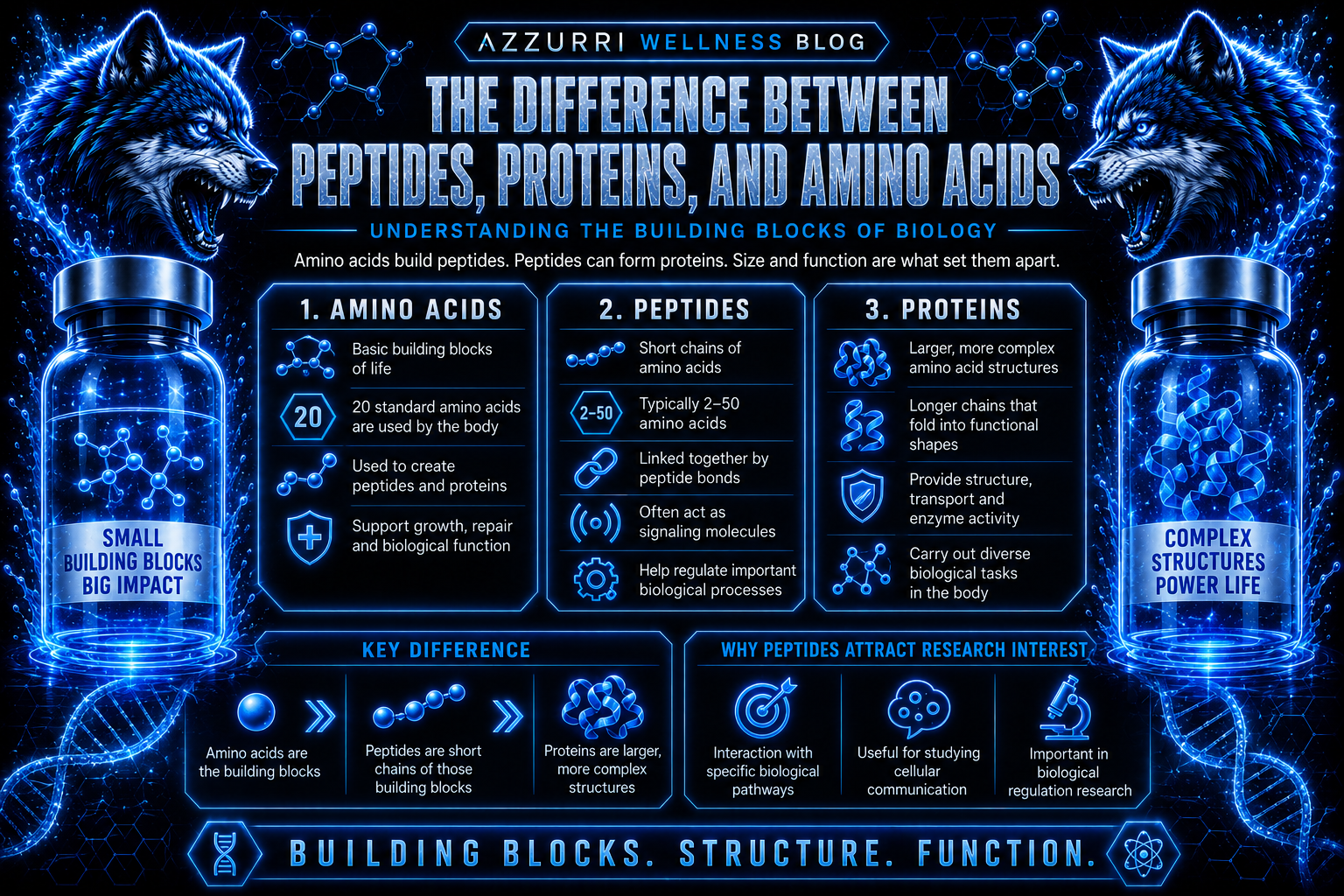
Peptides, proteins and amino acids get used almost interchangeably in casual conversation — but they are three different things on the same spectrum. Getting the difference straight makes everything else about peptides easier to follow.
Amino acids: the building blocks
Amino acids are the smallest unit. There are 20 standard ones, and every peptide and protein in your body is assembled from them in different orders. Think of them as the letters of an alphabet — on their own they are simple, but the order you put them in is what carries the meaning.
Peptides: short chains
Join a handful of amino acids together with peptide bonds and you have a peptide — usually defined as a chain of roughly 2 to 50 amino acids. Peptides are short enough to stay relatively simple in shape, which is part of why so many of them act as fast, specific signals: hormones and messengers that tell cells what to do.
Proteins: long, folded chains
Keep adding amino acids — dozens, hundreds, sometimes thousands — and the chain becomes a protein. At that length the chain folds into an intricate three-dimensional shape, and that shape is what lets proteins do heavy-duty jobs: enzymes that drive reactions, antibodies that fight infection, structural proteins like collagen. A protein is really just one or more long peptide chains folded into a working machine.
Side by side
| Amino acids | Peptides | Proteins | |
|---|---|---|---|
| Size | Single unit | ~2–50 amino acids | 50 to thousands |
| Shape | Simple | Short chain, little folding | Complex 3-D fold |
| Typical role | Building block | Signals & messengers | Enzymes, antibodies, structure |
| Example | Glycine, lysine | GLP-1, sermorelin | Insulin, collagen |
Why the distinction matters
The reason this matters for peptides used in a wellness setting is simple: their short length is a feature. Because they are small and signal-like, engineered peptides can be designed to switch a specific pathway on or off without the bulk and complexity of a full protein. That precision is exactly what makes them useful — and why so much modern research focuses on peptides rather than whole proteins.
Keep reading
- What are peptides? A plain-English guide
- How scientists design synthetic peptides
- The role of peptides in cellular communication
A quick, important note
Our products are prepared by a Registered 503B outsourcing facility and provided under physician guidance. This article is here to educate, not to replace medical advice. Your physician should be the one guiding peptide selection and use for your situation.