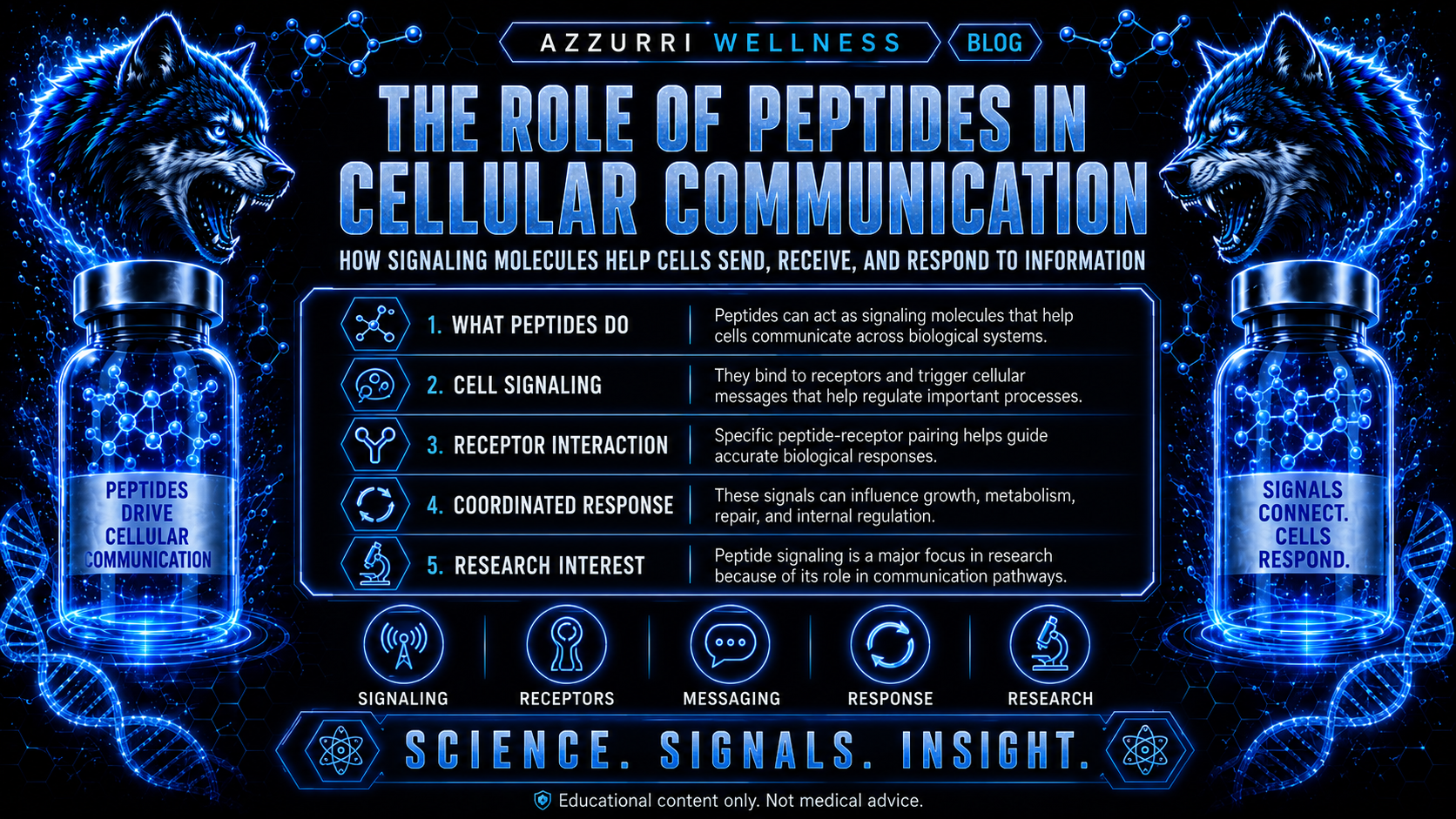
Your body runs on messages. Trillions of cells have to stay coordinated, and a huge amount of that coordination is handled by peptides acting as chemical messengers. Understanding that role is the key to understanding why peptides matter at all.
How the Message Gets Sent
A signaling peptide is released by one cell and travels — sometimes a short distance, sometimes through the bloodstream — until it reaches a cell carrying the matching receptor. The peptide fits that receptor like a key in a lock, and the moment it binds, it sets off a response inside the receiving cell.
What Happens on the Other Side
Binding is only the trigger. Once a peptide docks with its receptor, the cell can respond in several ways:
- release a hormone or another signal of its own,
- speed up or slow down a metabolic process,
- change which genes are switched on,
- alter how it grows, repairs or defends itself.
One small peptide, in other words, can set off a large and specific chain of events.
Why This System Is Everywhere
Peptide signaling touches nearly every system in the body. GLP-1 signals the pancreas to release insulin and tells the brain that you are full. Growth-hormone-releasing peptides signal the pituitary to act. Immune peptides coordinate the body's defenses. The common thread is communication — peptides are how distant cells stay on the same page.
Why It Matters for Engineered Peptides
This is the whole basis for how studied peptides work. Rather than forcing the body to do something foreign, most engineered peptides plug into these existing pathways — mimicking a natural signal, or extending how long it lasts. When you understand peptides as the body's messaging system, the way modern peptides are designed suddenly makes a lot more sense.
Keep Reading
- Understanding GLP-1
- The difference between peptides, proteins and amino acids
- What are peptides? A plain-English guide
A Quick, Important Note
Our products are prepared by a Registered 503B outsourcing facility and provided under physician guidance. This article is here to educate, not to replace medical advice. Your physician should be the one guiding peptide selection for your situation.