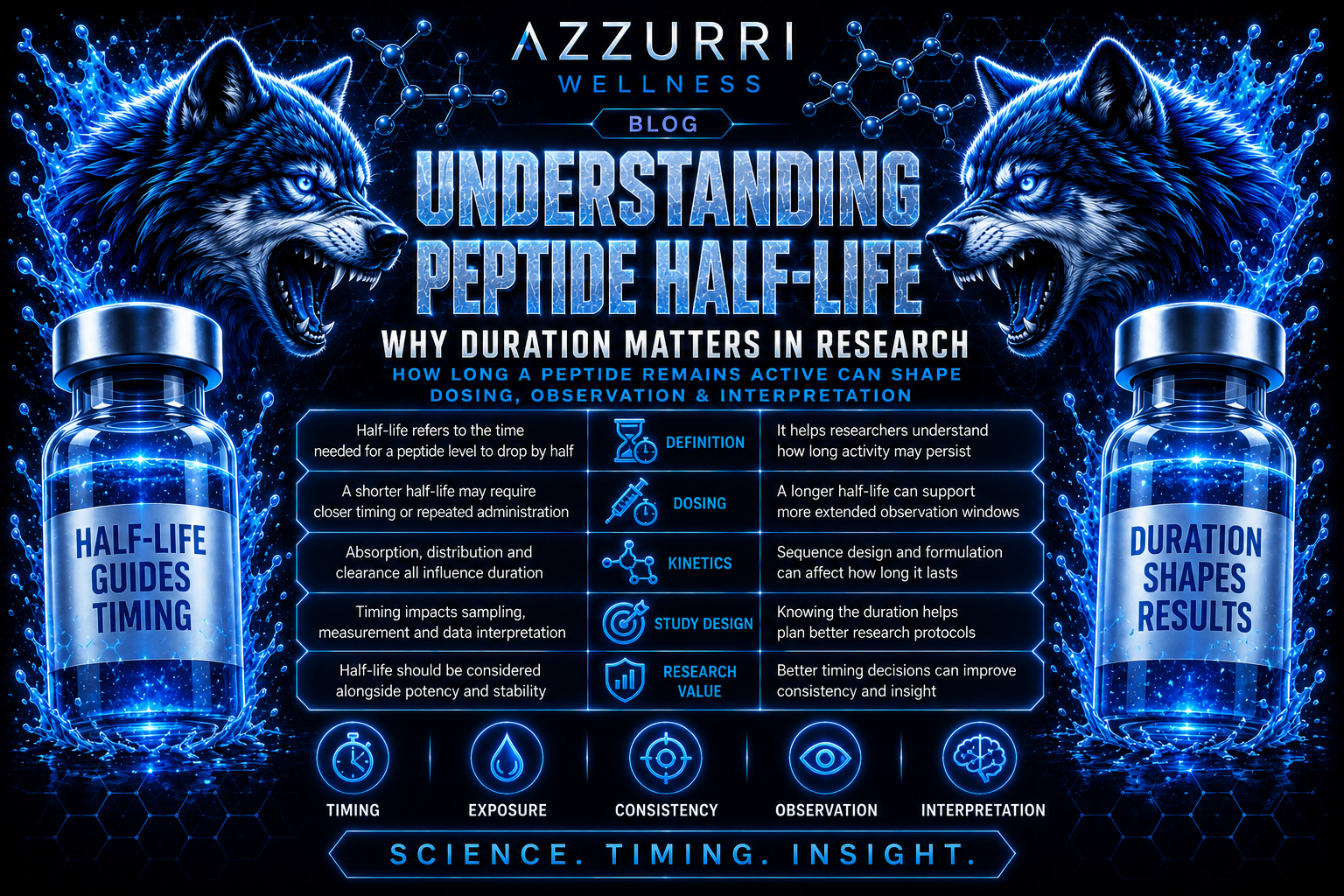
Ask about a peptide and the first question is usually what it does. There's a second question that matters just as much, though, and most people skip it: how long does it stay active once it's in you? That's half-life. It isn't a flashy number, but it decides most of the practical stuff, from how often a peptide needs re-dosing to how long it lingers after your last dose.
So what is half-life, really?
A peptide's half-life is simply the time it takes for your body to clear half of what's there. Say a peptide has a two-hour half-life: half is gone after two hours, a quarter after four, an eighth after six. There's a handy rule of thumb from pharmacology here — after about four to five half-lives, roughly 95% of a dose is gone, so that's the point where a peptide is basically cleared.
The same maths runs in reverse when levels are topped up repeatedly. It takes those same four to five half-lives to reach steady state, the point where levels settle into a stable average. And here's the part people find surprising: how fast you get to steady state depends on the half-life, not the dose. That's exactly why a long-acting peptide keeps building for weeks no matter what, and why levels are brought up gradually rather than starting at full strength.
How long do common peptides actually last?
The spread is huge — minutes for some, over a week for others. Here are ballpark figures. The numbers for the well-characterized peptides come from published trials; the rest come from smaller studies, and we've flagged the shakier ones.
| Peptide | Rough half-life |
|---|---|
| GHRP-6 / GHRP-2 | Minutes up to ~2.5 hours |
| Ipamorelin | About 2 hours |
| GHRH analog | Roughly 8–38 min (varies) |
| CJC-1295 without DAC | About 30 minutes |
| CJC-1295 with DAC | Around 6–8 days |
| Dual agonist (GIP/GLP-1) | About 5 days |
| Triple agonist | About 6 days |
| GLP-1 (long-acting) | Roughly 7 days (a week) |
| BPC-157 | ~15 min in animals; no confirmed human figure |
Two rows in that table trip people up. First, CJC-1295 with DAC and without DAC are basically different molecules; their half-lives differ by hundreds of times, so they behave nothing alike. Second, that BPC-157 figure is from animals. There's no published human half-life for it, so treat any confident "human" number you see online with suspicion.
Why does one peptide last minutes and another lasts a week?
Left alone, most peptides don't last long. Your body is very good at chopping them up. A handful of mechanisms explain the whole range in that table.
Enzymes, and one called DPP-4 in particular
Enzymes throughout the body slice peptides into fragments within minutes. One of them, DPP-4, matters a lot: it inactivates natural GLP-1 in a minute or two. The entire GLP-1 peptide class exists to dodge it. Without that trick, these peptides would be useless.
Your kidneys, and plain size
Small molecules get filtered out by the kidneys fast. Make a peptide effectively bigger — usually by tethering it to a large carrier protein — and it slips under the kidney's radar, which slows clearance dramatically.
Albumin binding, the big trick
Every long-lasting peptide leans on the same idea: a fatty-acid tail that lets it hitch a ride on albumin, the most common protein in your blood. That hides it from enzymes and makes it too big to filter out. There are two versions, and mixing them up is a common mistake:
- GLP-1, dual-agonist and triple-agonist peptides bind albumin tightly but reversibly (over 99% is bound at any moment), which buys them multi-day half-lives.
- CJC-1295 with DAC goes further and forms a permanent chemical bond to albumin, which is how it stretches to 6–8 days.
And a few other durability tricks
Chemists also build in unusual (D-form) amino acids that enzymes struggle to cut, loop the peptide into a ring so its ends are protected, or attach a polymer (PEGylation) to bulk it up. All of these buy time.
Why half-life shapes how often a peptide is given
The rough rule: a peptide is re-dosed on roughly the timescale of its half-life. That one fact explains the whole spread above. Long-acting peptides — GLP-1, dual-agonist and triple-agonist peptides, and CJC-1295 with DAC — only need re-dosing on a multi-day timescale. Short-acting ones — the GHRPs, a GHRH analog, Ipamorelin, CJC without DAC — clear within hours and have to be given far more often to keep levels useful.
One knock-on effect: because the long-acting peptides take four to five weeks to reach steady state, their benefits (and their side effects) keep climbing for over a month, and they take about that long to wash out when you stop. That slow build is the whole reason physician guidance matters.
Three things people get wrong
- "Half-life is how long it works." Not quite. It measures clearance, not effect. A downstream response (an IGF-1 bump, say) can outlast the peptide, and a quick burst of activity can be shorter than the half-life. Related, but not the same.
- "Give a long-acting peptide more often and it kicks in faster." It won't. Time-to-steady-state rides on half-life alone. More frequent dosing just raises the plateau, and the side effects with it.
- "BPC-157 has a known human half-life." It doesn't. Every number floating around is extrapolated, usually from rodents.
Keep reading
- Why Peptide Stability Matters: From Manufacturing to Storage
- Triple vs Dual Agonist Peptides Compared
- Triple-Agonist Peptides: What the Studies Examine
- BPC-157: What the Preclinical Studies Examine
- What Are Peptides? A Plain-English Guide
A quick, important note
Our products are prepared by a Registered 503B outsourcing facility and provided under physician guidance. This article is here to educate, not to replace medical advice. Your physician should be the one guiding peptide selection, dosing and storage for your situation.