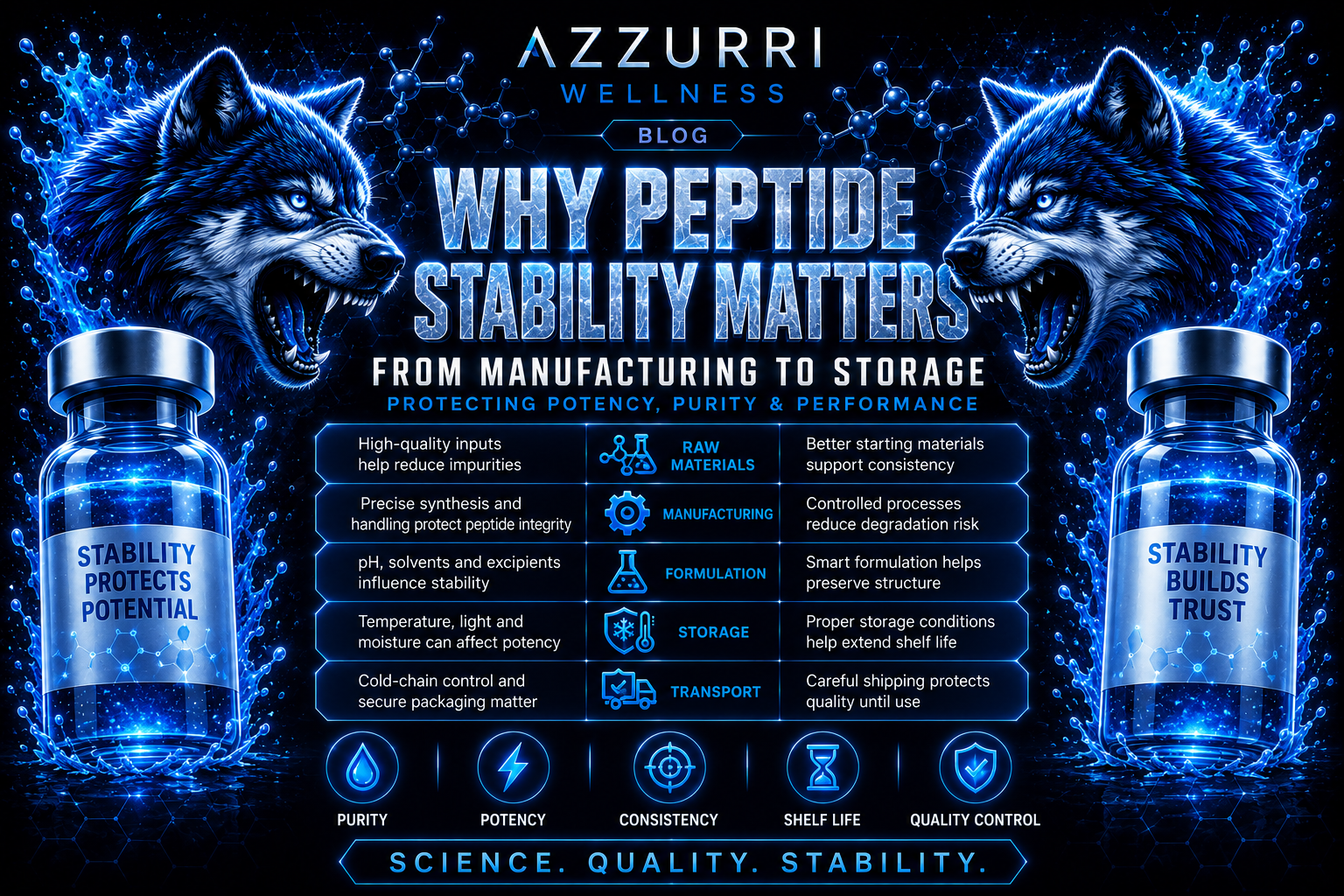
A peptide is only as good as its condition the moment you use it. From the factory through shipping to your fridge, keeping its structure intact is what protects potency. And the tricky part is that degradation is invisible: a vial can lose strength with nothing visibly wrong. Here's how peptides break down, the temperatures that protect them, and how to handle them properly.
What actually breaks a peptide down
Peptides are chains of amino acids, and a few chemical reactions can pull them apart. Knowing these makes every storage rule further down click into place:
- Hydrolysis. Water splits the peptide bonds. This is the big one, and it's why a dry powder outlasts a peptide in solution and why moisture is the enemy.
- Oxidation. Oxygen and UV light go after specific residues, especially methionine, cysteine, tryptophan and histidine. Hence the fuss about light and air.
- Deamidation. Asparagine and glutamine residues slowly convert to other forms, sped up by heat and by anything above about pH 6.
- Aggregation. Molecules clump into insoluble bits, which you might spot as cloudiness in a reconstituted vial.
Peptides carrying those sensitive residues just don't keep as well, so they need extra care.
Storage temperatures and how long things last
Since water drives most of the damage, the freeze-dried powder is by far the sturdiest form. Keep it cold and dry and it lasts. These are typical figures from manufacturer guides; the real number varies by peptide.
| Form & condition | Roughly how long it keeps |
|---|---|
| Dried powder, room temp (20–25°C) | Short-term only — days to a couple of weeks |
| Dried powder, fridge (2–8°C) | About a year |
| Dried powder, freezer (−20°C) | Two years or more |
| Dried powder, ultra-low (−80°C) | Five years-plus |
| Reconstituted, fridge (2–8°C) | Around four weeks (28 days) |
| Reconstituted, room temp | One to two weeks (best avoided) |
That 28-day figure for a mixed vial is a useful anchor: it lines up with the standard beyond-use date for bacteriostatic water once you've punctured it. Sturdy peptides might stretch a bit longer; sensitive ones can start slipping within a couple of weeks.
Dried vs. reconstituted: why it's night and day
Freeze-dried (lyophilized) peptides have had the water pulled out, which shuts down hydrolysis and deamidation. They keep for months or years, ship fine at room temperature, and forgive a bit of rough handling. Once you mix a peptide with solvent, all of that changes: it's now vulnerable to temperature, contamination and every reaction above. So the rule is simple — keep peptides dry and cold until you genuinely need them.
Reconstituting without wrecking it
Honestly, this is where most avoidable damage happens. A few habits make a real difference:
- Reach for bacteriostatic water when it's appropriate. Its 0.9% benzyl alcohol holds back bacteria, which is what gives a multi-use vial that ~28-day refrigerated window instead of a much shorter one with plain sterile water.
- Add the solvent slowly, aimed at the glass, so it runs down the wall rather than blasting straight onto the powder.
- Swirl, don't shake. Shaking foams and shears the peptide, which can denature and clump it. Let it dissolve gently.
Freeze-thaw cycles (and why to aliquot)
Freezing and thawing a solution over and over is sneakily destructive. Each time ice forms, the peptide gets crammed into a shrinking pocket of liquid, the local pH shifts, and the moving ice edge shears it. The upshot is aggregation and lost activity. Keep it to a handful of cycles at most, and better yet, split the solution into small single-use portions before freezing so you only thaw what you'll use.
Light, air, moisture and free cysteine
A few smaller things worth knowing: store light-sensitive peptides in amber vials or wrapped from the light; let a cold vial warm up before you open it so condensation doesn't settle on the powder; and know that peptides with free cysteine residues oxidise readily, especially at higher pH. None of these are dealbreakers, but they add up.
Why purity and stability go hand in hand
Purity (that HPLC percentage you see) and stability are linked more than people expect. The impurities in a lower-purity peptide aren't inert — they can actively speed up the breakdown of the good material, so cheaper crude peptides degrade faster and less predictably. And since none of this shows on the outside, a vial that's quietly lost 10% of its potency looks identical to a fresh one. That's the case for both a high starting purity and proper storage, and for buying from a facility that takes them seriously.
Keep reading
- Peptide Half-Life Explained: Why Duration Matters
- What Are Peptides? A Plain-English Guide
- BPC-157: What the Preclinical Studies Examine
- Sermorelin: Benefits & Overview
A quick, important note
Our products are prepared by a Registered 503B outsourcing facility and provided under physician guidance. This article is here to educate, not to replace medical advice. Your physician should be the one guiding peptide selection and storage for your situation.